
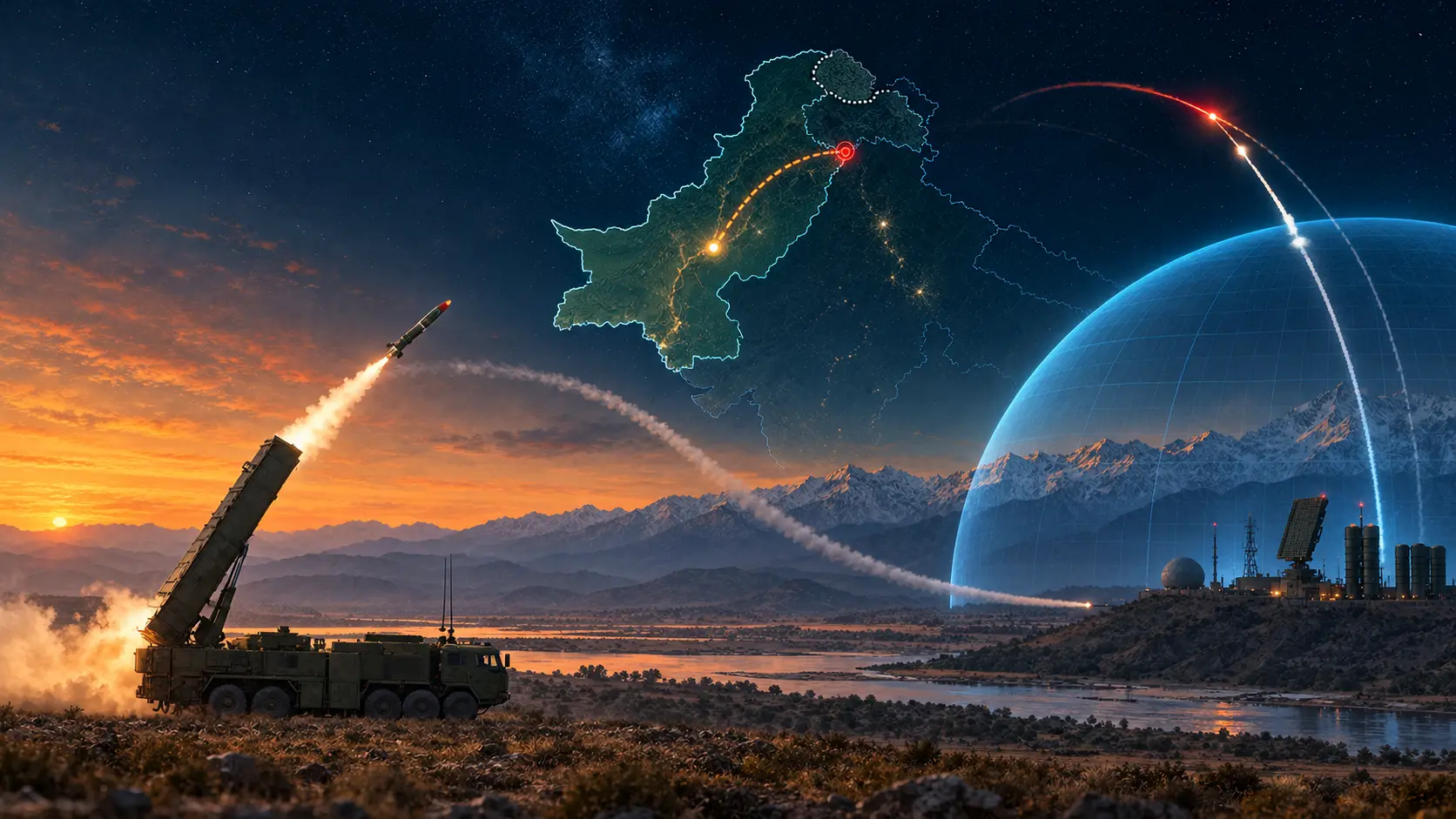
Pakistan this week tested an extended-range version of the Fatah-4 ground-launched cruise missile. Most commentary will not ask why Pakistan keeps refining a subsonic, terrain-hugging missile while the rest of the world talks about hypersonics, but that question explains how Pakistan thinks about conventional war. Most public understanding of hypersonic weapons and the discourse around it seemingly is nothing more than the buzz. Strictly, anything above Mach 5 is hypersonic, which means almost every ballistic missile with a range of more than a few hundred kilometres has been hypersonic in its terminal phase since the V-2. What the current excitement refers to, while failing to reach for it, is a narrower class: boost-glide vehicles and scramjet-powered cruise missiles that combine high speed with manoeuvre in the upper atmosphere. Their value depends on the geometry of the theatre, the defences they must defeat and the targets they must hold at risk. Where those conditions are absent, a hypersonic weapon is only an expensive way of arriving early, and that is why not every serious military has rushed to treat hypersonics as a revolution.
In the India–Pakistan theatre, those conditions are largely absent at the conventional level. The threat India has invested most heavily to counter is precisely the high and fast one. The S-400 is built around long-range surveillance and engagement radars that see high-altitude, high-velocity targets at great distance, and its interceptor family was designed for that problem. A hypersonic vehicle of the kind Pakistan could build with its current investment and industrial base would fly in the very envelope the S-400 is optimised to watch. It would be detected early, tracked for long and engaged by interceptors made for that task. At the tactical level, such a weapon adds little to Pakistani offence and nothing to its defence.
Pakistani conventional procurement has always favoured specificity over spectacle, and the CM-400AKG is the clearest proof. That was spec’d by the PAF engineers and they were not datasheeting some generic stand-off weapon; like several systems that people mistake for off-the-shelf Chinese or Turkish products, it was developed to Pakistani specifications for the very reason which became evident on its first use. The PAF specified its quasi-ballistic profile, a steep, high-speed terminal dive after release from a JF-17 platform, for one task: to reach high-value targets faster than they could react. On the night India launched its strikes, I named the CM-400AKG as the PAF’s answer, and I had speculated well before May 2025 that the S-400 would be its target. Three days later, the S-400 at Adampur was neutralised . Fatah-4 comes from the same school of thought.
Fatah-4 is a subsonic cruise missile derived from the Babur family and held by the Army Rocket Force Command. Its configuration tells you which systems and which command-and-control architecture it is meant to defeat. It flies a terrain-hugging profile and uses DSMAC [Digital Scene Matching Area Correlator, which compares a live camera image of the ground with stored reference imagery to correct the final aimpoint] for terminal accuracy. In my own experience with the subject, this guidance chain is the product of roughly twenty-five years of development inside the strategic circles, and it precisely targets the S-400 at its geometric weakness rather than at its strength.
The extended version matters more than the headline suggests. ISPR did not give a figure, but my assessment is that the range now sits between 1,000 and 1,250 km, up from the 750 km of the original. The obvious reading is reach, and from launch areas in Punjab and Sindh that range brings Delhi, the air bases of Rajasthan and Gujarat, and Mumbai’s Western Naval Command within comfortable range. The more important reading is routing and survivability. A terrain-hugging cruise missile spends fuel faster at low altitude, and it seldom flies a straight line, because it doglegs around known radar coverage and enters from the direction the defender least expects. Every additional kilometre of range buys freedom of route, not only distance. The extra range also lets ARFC launchers stand back west of the Indus, beyond the reach of Indian short-range strike and quick-reaction pursuit, while still holding the same target set at risk. ISPR’s reference to enhanced survivability points exactly towards that plan of improving the survival of the force that launches the weapon besides the weapon itself.
Now, the S-400’s geometric weakness is the radar horizon. A missile flying 15 to 30 m above the ground cannot be seen by a ground-based radar until it crosses that horizon, which for a mast-mounted engagement radar a few tens of metres high sits at roughly 30 to 40 km. At subsonic speed, the battery then has a window of about two to three minutes to detect, classify, assign and fire, and the terminal layers have far less; when I assessed Pakistan’s own air-defence grid before the May 2025 exchange, the reaction window against a terrain-hugging SCALP came to about twenty seconds. In that window, the long-range 40N6 interceptor, the S-400’s headline capability, has no role at all. Only airborne early warning, such as India’s Netra or the A-50EI Phalcon, extends the horizon, and those aircraft must be airborne, on station and networked to the right battery at the right moment. Fatah-4 turns the contest from a race of speed into a race of networks and timing, which is where the Indian air-defence system is most fragile. As I argued in The missile is not the constraint. The network is. , May 2025 proved the point: the weapons were ordinary, and the networks decided the outcome.
By my assessment, Fatah-4 delivers at least 60 per cent of the effect of the CM-400AKG’s quasi-ballistic attacks, without committing a JF-17 to contested airspace and without assembling the expensive kill chain behind it: airborne early warning, ISR, escorts, SEAD packaging and the risk to aircraft and aircrew. A dispersed ground launcher risks no pilot, and the cost of a round is a fraction of the cost of a strike package.
The doctrinal significance follows from this. A platoon of Fatah-4 launchers with a magazine depth of ten rounds or fewer would be sufficient as a deep-strike enabler. Its task would not be to win the war alone but to open the door: to degrade radars, air-defence command posts and air-base infrastructure in a timed sequence, so that J-10Cs and Mirages can operate deeper and with lower attrition. In effect, an army-held conventional missile force becomes the first wave of the air campaign at Day Zero. On the ground, the same deep fires against Pathankot, Adampur and Ambala would let I Corps drive its Hammer Strike thrust up the Ravi–Chenab corridor under a friendly sky. Because a Babur-derived airframe shares its flight profile with a nuclear-capable system, the defender faces warhead ambiguity. Pakistan answered that problem in advance by placing these weapons under the ARFC, a distinct conventional command with a clear chain of authority, which keeps conventional signalling separate from the strategic tier.
Geography is the second reason hypersonic weapons add little to Pakistan’s conventional advantage. Pakistan has almost no strategic depth. Lahore sits about 25 km from the border. The GT Road and M-2 corridor, the Indus and the N-5 artery, and the cantonments of Punjab all lie within a few hundred kilometres of Indian launch areas, and Karachi is within easy reach from the Kutch and Sir Creek sector. India, by contrast, stretches roughly 2,000 km to the east, and the Andaman and Nicobar Islands lie close to 3,000 km from Pakistani territory. Russia spans about 9,000 km, and the United States sits behind two oceans and fights from bases thousands of kilometres from home. As I wrote in The Express Tribune in June 2025, Pakistan’s threshold is calibrated not in megatons but in minutes. Hypersonic weapons were conceived for the continental distances of the great powers, not for ours.
Let’s have a quick arithmetic on timings to make this all clearer. Against a target 300 km away, a subsonic cruise missile needs about 18 minutes, a ballistic missile such as Fatah-2 needs four to five minutes, and a Mach 6 vehicle needs about three. The hypersonic weapon saves a minute or two over systems Pakistan already fields, and a defender at war-time alert absorbs that difference easily. At 3,000 km, the comparison is between three hours for a cruise missile and about 25 minutes for a hypersonic vehicle. That is a change in kind, and it explains why Washington, Moscow and Beijing invest in these systems. On the Punjab front, Pakistan’s problem is not arriving faster. It is surviving the first hours, dispersing its launchers and striking with precision, and Fatah-4 is built for exactly that problem.
This is the clearest on littoral defence. Pakistan’s coast runs about 1,000 km from Sir Creek to Jiwani, and the Navy operates with its full strength inside an umbrella that the PAF provides. JF-17 Block IIIs from southern bases reach any point of that littoral within 15 to 20 minutes, and the Navy adds its own Harbah cruise missiles and the 350 km SMASH ship-launched ballistic missile. Inside that umbrella, Pakistan already has the speed it needs. As I set out in Silent Depth , the CM-400AKG was conceived first as a carrier killer, with a quasi-ballistic profile and terminal hypersonic velocity designed to defeat a moving ship; the weapon that struck the S-400 was a tweak of that design. A separate hypersonic programme inside the PAF’s umbrella would add cost, not effect.
Hypersonic systems therefore belong in Pakistan’s strategic tier, and the work there has been under way for some time. In June 2025, when Western assessments read overhead imagery of Pakistani static test stands, composite filament-winding facilities and clustered solid-motor trials as evidence of an ICBM programme, I argued that the same infrastructure fitted hypersonic development far better: boost-glide vehicles on depressed trajectories, manoeuvring re-entry vehicles built to defeat ballistic missile defence, and glide vehicles with lift-generating airframes and cross-range capability. The task of such systems is to hold all of India at risk, including the Tri-Service Command at Port Blair, the Eastern Naval Command at Visakhapatnam and the submarine base at Rambilli, which is being built for India’s ballistic missile submarines. India’s expanding first-strike toolkit, from MIRV-capable Agni missiles to INS Arihant and INS Arighat and staging posts across the Indian Ocean beyond Pakistan’s current ballistic envelope, is what makes that reach necessary. Also, such hypersonic systems launch areas will most likely sit behind the Himalayan and Hindu Kush ranges, where the mountain mass blocks Indian radar line-of-sight and complicates any pre-emptive strike.
The more important purpose, however, is maritime. Speed matters most against a target that moves. A carrier steaming at 30 knots covers about 55 km in an hour. A subsonic missile on a 750 km flight needs close to 50 minutes, and in that time the carrier can move some 45 km, well outside the seeker’s search area unless the missile receives mid-course updates. A Mach 6 vehicle covers the same distance in about seven minutes, so the carrier moves only about 6 km and the seeker still finds it. The steep, high-speed terminal dive also compresses the reaction time of shipborne defences such as that of Barak-8 which Israelis supplied to Indians to install on naval assets. Speed alone, however, does not close the kill chain. At those distances over open sea, someone must find the carrier and update the weapon, and that task lies beyond the current reach of Pakistani UAVs or manned sorties over contested water. Chinese ISR and SATCOM, already proven in operational integration through that PL-15 kill chain, provide that backbone and extend the full ISR-to-strike cycle into the open ocean. The CM-400AKG already applies this logic out to its publicly listed 240 to 290 km. A Pakistani strategic hypersonic system would carry it far beyond the PAF’s umbrella, into sea denial on an oceanic scale: holding INS Vikrant, INS Vikramaditya and the larger Indian surface combatants at risk wherever they sail in the Arabian Sea, and keeping Indian carrier groups out of the waters from which they could threaten Karachi, Ormara and Gwadar. With that capability fused to a working kill chain, Pakistan would become the fourth state, after the United States, Russia and China, to field this class of anti-access and area-denial capability.
When Pakistan fields hypersonic systems, it will field them for that purpose and in that tier. For the conventional battle, Pakistan has already chosen its path: weapons specified for a target set, a command structure built around them, and steady refinement of proven technology rather than pursuit of a label. Fatah-4 is that philosophy in its clearest form. At both tiers, the logic is the same hard deterrence theory: the purpose is not to win a race of speed but to deny any adversary the illusion of victory.
More on this, and on what the configuration tells us about the intended target set, in a later piece.