May 09, 2025
Note
This article was written 09 May 2025 on X. As the post was written, PAF’s AVM Aurangzeb in press briefing officially announced the speculations made in the post.
A common question, even posed to me multiple times, since the recent escalation: why didn’t Pakistan intercept the incoming Indian projectiles? The answer isn’t doctrinal, capacity, or priority – it’s physics.
As we have seen in Azerbaijan, Ukraine, Russia, Israel, and elsewhere, even the most sophisticated systems – THAAD, NASAMS, SAMP/T even with Aster-30, Patriot, S-400, you name it – are statistically incapable of guaranteeing 100% interception against modern, low-observable, terrain-hugging munitions like Storm Shadow/SCALP-EG, SPICE-2000, and Russian engineered BrahMos-A. These systems are engineered to defeat radar-based and layered defences.
But more crucially, this wasn’t a general scenario. In the actual Indian strike campaign, over 70+ aerial assets were fielded, with 5–6 strike-configured Mirage-2000s forming the offensive core. Internal PAF simulations, doctrine development, and years of training had already quantified the probability of intercepting 29+ projectiles under such a campaign configuration and within a limited engagement window. The total flight time of munitions like SCALP-EG or SPICE-2000, flying nap-of-the-earth at 800–900 km/h, leaves a narrow 3–5-minute reaction window after confirmed launch—a margin that compresses sensor-to-shooter loop beyond what even integrated networks can routinely manage. Simulations conclude a calculated interception probability of <10%, even when combining PAF and Army Air Defence assets. No military in the world, not even the US Air Force or PLAAF, would rely on a 10% chance to secure its skies. And certainly not the Pakistan Air Force. Add in this calculus that in such multi-axis campaigns, SEAD/DEAD elements are often integrated to suppress radar emissions and degrade AD response, further shrinking the interception window.
That’s why Pakistan didn’t gamble with interception, in fact our HIMADS, too, went all guns after their fighters. Interception wasn’t worth it. PAF’s doctrinal DNA has evolved since post-Kargil introspections, where Pakistan realised the cost of linear air defence without deep air denial. The present strategy is the outcome of that evolution.
And this wasn’t a hunch, it was known by heart to PAF’s field commanders and senior leadership, drilled into operational routines through extensive wargaming, evaluation models, and codified ROEs
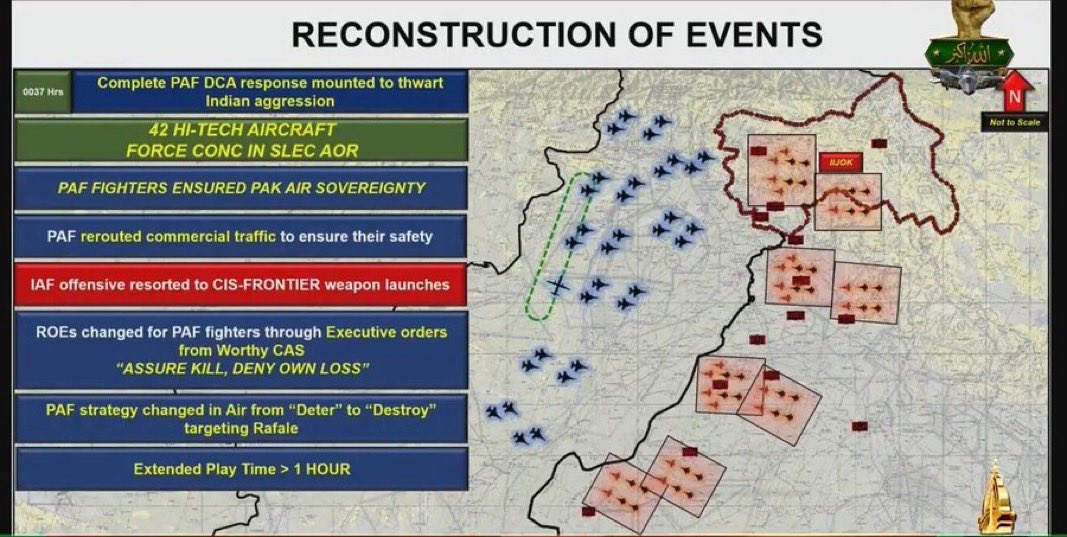
Given such an unfavourable probability for defending fixed targets of no strategic or tactical importance, the strategic shift becomes self-evident: the strike package, not the projectile, should be the centre of gravity. That is the essence of Pakistan’s aerospace doctrine: to intercept and degrade the offensive wave before or during weapons release, where probability of success multiplies.
This is why PAF did not initiate a projectile defence posture, it went on offence and aggressive posturing within a minute of first foe’s projectiles trajectory confirmation. To go on offence in a defensive entropy, requires an extremely high level of professionalism, courage and mentality.
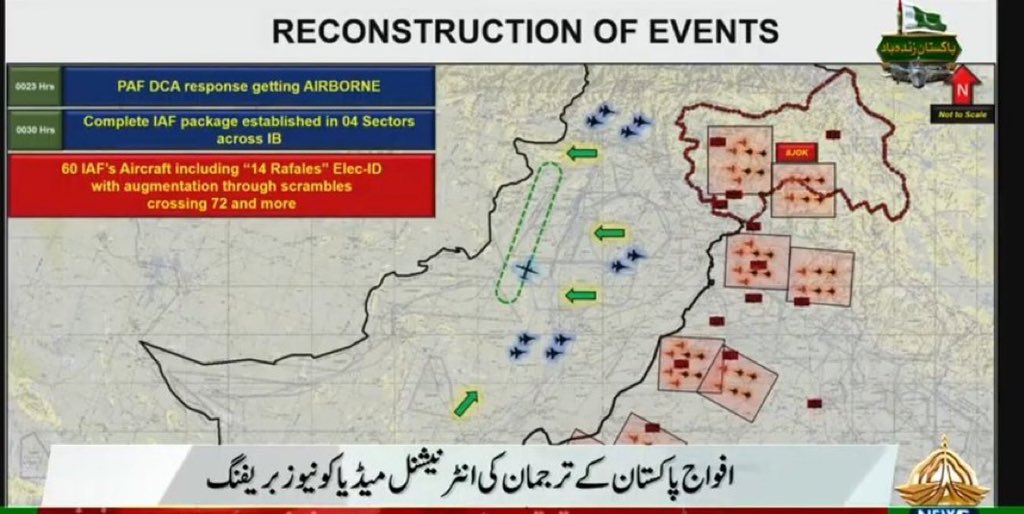
The Indian Air Force had issued an aerial exercise NOTAM; a procedural norm observed by both air forces, even during high alert periods. PAF had its standard Combat Air Patrols (CAP) on routine but strengthened to match the Indian announced drills, a routine action built into standing ROEs. As Indian formations turned Red, decentralised commanders, empowered under Pakistan’s evolved ROE framework, elevated the posture. With no need for political or top-down clearance, PAF’s forward commanders began offensive engagement of the campaign.
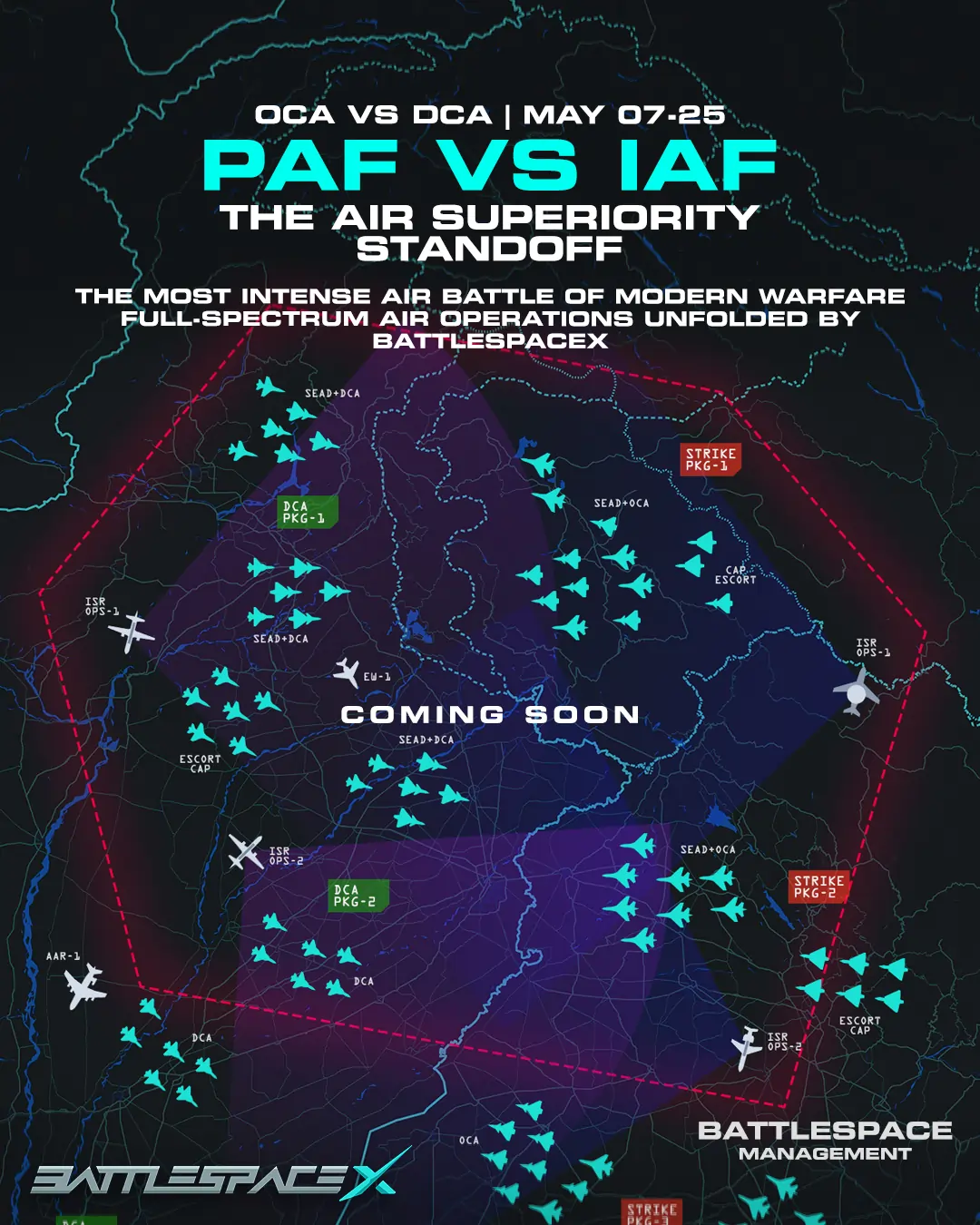
The size of the aerial corridor was extensive, over 700 km, from South Punjab to the LoC and above. Total aerial saturation was 125+ aerial assets: 70+ of Indian offensive assets in 3–4 squadrons and 7–8 strike elements, supported by AEW, EW, and escorts, the rest were PAFs. PAF’s CAP engaged a force nearly double in size and rather superior in multirole configuration. That is why, instead of reacting across a stretched defence line, PAF implemented force concentration, using the TSR Matrix (Time-Strength Ratio), on Upper Punjab and LoC corridor to mass effects where Indian formations were most vulnerable. A principle rooted in Lanchester’s Square Law developed since WWI and adopted by all professional advanced armies in the world in all naval, ground and aerial theatres.
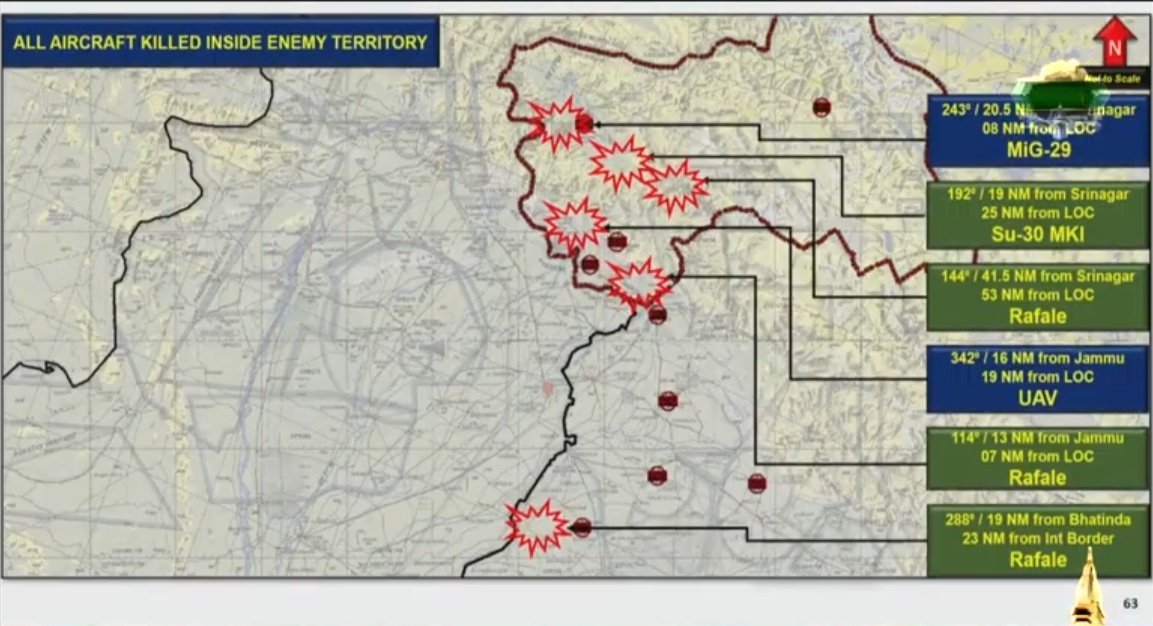
With that, PAF engaged only those aircraft that had released weapons as DG ISPR revealed, a calibrated, ROE-compliant targeting strategy but one-down from engaging weapon bearing aircrafts. Had PAF gone up a notch we could’ve 10 downed jets, but such trigger-happy behaviour would have been unbecoming of a professional air force. In total, five Indian aircraft and a MALE UAV were neutralised, including three Rafales. The mission was prosecuted with discipline, restraint, and precision—not one missile was wasted, not one engagement fell outside threshold. Notably, India’s lack of common data link and degraded IFF integration, especially across mixed-platform formations, proved catastrophic. In fact, one Indian jet was downed by Indian fire, a direct result of IFF confusion due to poor training and platform integration. Indian AF and AD are increasingly becoming notorious of their fratricide-fame. The problem is that unlike PAF’s integration via Link-17 and common ROE matrix, the IAF still lacks a theatre-wide aerial battle management system, a critical gap that magnifies risks of fratricide and coordination breakdown in real-time saturation warfare. Just think that in such an intense package, the Indian commanders fielded a UAV to plugin for EW platforms or jamming, this was obviously taken out first by SAMs.
That is why this operation has drawn focused study in global defence centres, not because it was loud, but because it was quietly flawless, surgical and almost textbook. And that is harder.
As I speculated earlier, the moment Rafales go silent, it’d get quite loud. From Washington to Paris, Brussels to Tel Aviv, the silence becomes a signal: measured, professional, unmistakable. Western observers have rightly assessed PAF’s dominance in the largest aerial engagement since WW-II. News, media, and markets have spoken. Think tanks are speculating the future of global and especially South Asia’s air power equilibrium. Today, silence hangs heavy over Ambala, Gwalior, Jodhpur, and the entire Indian Air Command chain. Not just because of what they lost—but because of what they failed to understand.
Pakistan didn’t chase drama; it executed probability. When merit aligns with method, what follows is not chaos but control – surgical, calibrated, and repeatable. This is the dividend of discipline; and it was only the first act.