
May 07, 2025
Note
This article was written on the night of 07 May 2025 on X, just after India’s botched Operation Sindoor.
What is coming next ⁉️
To keen observers, it was obvious early on: there were few ambiguities, fewer surprises. I had noted the likelihood well in advance — that India would opt for standoff-range strikes, factoring in their obvious poor training, using French SCALP and Israeli SPICE munitions, with the possibility of BrahMos variants. These predictions weren’t hard to make; they flowed from doctrinal shifts and India’s visible procurement trajectory. Also obvious was that no air defense, however layered, can guarantee 100% interception in a modern war theatre — especially against low-observable, terrain-hugging missile systems designed to exploit radar gaps. That, too, has played out. And when the possibility of a J-10C versus Rafale encounter was raised, it was highly probable based on precedent and recent posturings that Pakistan’s fighters, empowered with ROE autonomy, hardened and proven kill-chains, armed with PL-15s, would dominate. That’s exactly what has happened — Rafales were jammed for 3 days and on 4th were downed by HQ-9Es and PL-15Es indicating the foretold effectiveness of PAF’s Air Combat Control Center (ACCC).
Now, with the Indian strikes confirmed inside Pakistani territory — importantly near Bahawalpur/Ahmedpur East, Muridke, etc — the cycle has moved into its second phase: retaliation. This isn’t uncharted territory for Islamabad. Pakistan’s retaliatory options are wide, well-developed, and grounded in a mature strategic doctrine. Both India and Pakistan know how to manage each other’s expectations. That mutual awareness — forged through decades of Cold Start rehearsals and tactical signaling — is exactly what has kept the lid on so far. Pakistan’s full-spectrum deterrence doctrine makes it clear: retaliation will begin with conventional military responses, calibrated to inflict cost and restore psychological balance without crossing into nuclear threshold territory. The idea is simple — hurt enough to compel pause, but not provoke annihilation.
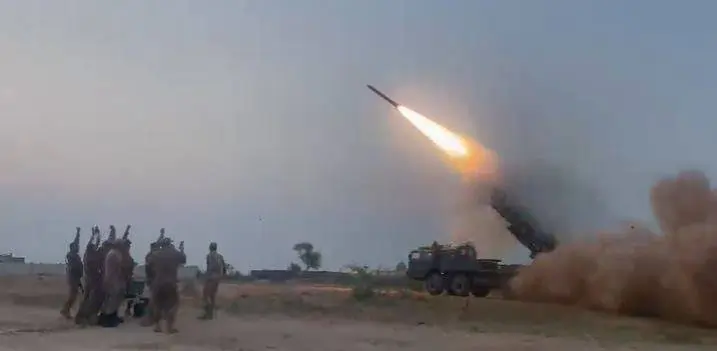
The full spectrum doctrine isn’t theoretical — it’s operational. And recent capability additions have made it sharper. Abdali missile, for example, was re-tested just few days ago to single a range increase of 400+ km and terminal maneuverability. That makes it an ideal for hitting Indian forward bases in Kashmir, Ambala or Bhatinda. Then there’s the Ra’ad II, an air-launched cruise missile with 550+ km range, capable of hugging the terrain and delivering pinpoint strikes. This gives Pakistan the option to mirror SCALPs that India used. Add to this the PAF declared possession of hypersonic weapon system most likely some CM-400AKG variant — Mach 4+ class carrier killer/land missile with ~240 km quasi-ballistic range — and you have a versatile air response spectrum balancing out all delivery options India has used.
There’s one more thing, a rather significant one, which is Pakistan’s access to next-generation AI-powered munitions. The Kemankeş 2, especially its KaGeM V3 variant — co-developed by Baykar and NASTP — represents a leap in indigenous autonomy. This loitering missile blends onboard AI neural models, ISR integration, and real-time decision-making to select and prosecute targets, even in jamming-heavy environments. Such munitions are perfect for surgical strikes against air defense nodes, fuel dumps, or hardened aircraft shelters. In a conflict scenario shaped by sensor saturation and rapid data loops, these tools will matter more than tonnage.
Naval deterrence also figures into the calculus as surprise element. The Babur-3 submarine-launched cruise missile, with its ability to reach coastal Indian installations and remain undetected until launch, forms the backbone of Pakistan’s second-strike credibility. Even if not used immediately or used in some non-nuclear way, the fact that it is deployable complicates any Indian assumption of escalation dominance.
On the targeting side, Pakistan’s response will likely be geographically and morally symmetrical. If the Indian strikes originated from Ambala or Gwalior, Pakistan’s likely response would be to strike the originating airbases — runways, depots, radar nodes — in kind. This maintains proportionality, avoids civilian casualties, and reinforces the clarity of its doctrinal intent.
There’s also the overlooked factor of Indian infrastructure on Western rivers. The fact that projectile fragments from the Indian attack landed near the Neelum–Jhelum project opens the door — diplomatically and militarily — for retaliation against infrastructure like the Baglihar or Ratle Dam. If not the spillway or main dam structure, it could be the power station or its switchyard to assert dominance. While escalation management is critical, such a target — if struck in a calibrated fashion — can serve as a sharp message: proximity to water war is not off the table if kinetic red lines are ignored.
There are also other pressure points. Striking facilities linked to RSS ideological coordination or the network suspected of orchestrating incidents like the Jaffer Express attacks would signal a broader, irregular warfare counter-punch — framed not as escalation, but as counter-terror retaliation to hand in the response irrationality in kind.
All this forms part of a wider framework: a response that is unmistakably painful, but technically restrained. Pakistan doesn’t need to use nukes to demonstrate resolve. Its arsenal — kinetic and psychological — is built to show that limited war, if imposed, will not remain cost-free. And in this phase, mimicry will play a key role. Just as India used SCALP, SPICE, and BrahMos, Pakistan will respond with Ra’ad II, KaGeM, and CM-400AKG — similar ranges, similar precision, similar ambiguity. Pakistan doesn’t care for optics or cinematic theatrics but it does deliver the message parity every time clearly.
The reality is: both sides know each other’s escalation ladders very well. There are backchannel lines, intelligence estimates, and deeply institutionalized wargaming models on both ends. So while emotions run high on social media and TV, the militaries are likely to act within established expectations. Therefore, this unfolding dynamic isn’t about one-upmanship. It’d be about reinforcing deterrence credibility. The next few days will test that pairing. Islamabad’s task isn’t to escalate — it’s to restore balance without losing initiative. And that’s where doctrine, once again, takes center stage — cold, rational, calibrated. The message has reached to Brussels, Paris, Washington, New Dehli and Tel Aviv, as already warned, the next stage is going to alter the course of history of this region altogether. Kashmir is not going anywhere, it is what defines the existence of Muslim-Hindu parity. No coercive shutdown or turn away will force Pakistan back. The recent spectacles at state-backed funerals is telling the future.
Lastly, some words from ‘65 war’s famous Himayat Ali Shair:
ساتھیو ! مجاہدو! جاگ اٹھا ہے سارا وطن ساتھیو ! مجاہدو! دل میں قرآن ہونٹوں پہ تکبیر ہے جوشِ عباسؓ ہے عزمِ شبیرؓ ہے ہر مسلمان حیدرؓ کی شمشیر ہے سر پہ سایہ فگن دستِ خیبر شکنؓ ساتھیو ! مجاہدو! جاگ اٹھا ہے سارا وطن ساتھیو ! مجاہدو!
#PakistanZindabad