
May 22, 2025
❗️If it weren’t for the US-Russia ties in 1961, the world could have collapsed during the Cuban Missile Crisis — Rubio
The world learnt many lessons from those 13 days — doctrines were developed, safeguards installed, hotlines opened. India seems to have learned nothing from that even after 63 years. It, perhaps, cannot.
This is a country that “accidentally” fired a nuclear-capable hypersonic missile into Pakistan in March 2022. A Russian-engineered P-800 Oniks, rebranded as BrahMos, went off-course and landed deep inside a nuclear-armed neighbour. No heads rolled. No systems reviewed. Just a sorry scapegoating at IAF. In 2010, a shipment of radioactive cobalt-60, improperly disposed of from a Delhi university lab, killed one person and injured several others in a scrap market. In 2017, a GPS malfunction caused an Indian Agni-II nuclear-capable missile to deviate during a test, nearly hitting a populated area. In 2014, a valve failure at the Kakrapar Atomic Power Station caused a partial reactor shutdown, with delays in containment risking radiation leaks. In 1995, a coolant pipe burst at the Rajasthan Atomic Power Station exposed workers to excessive radiation due to poor maintenance. In 2002, a fuel rod mishandling at the Kalpakkam Reprocessing Plant led to a radiation spike, endangering workers and nearby communities. This is the country that the West and the US opted for nuclear proliferation and BECA agreements, endorsing recklessness effectively.
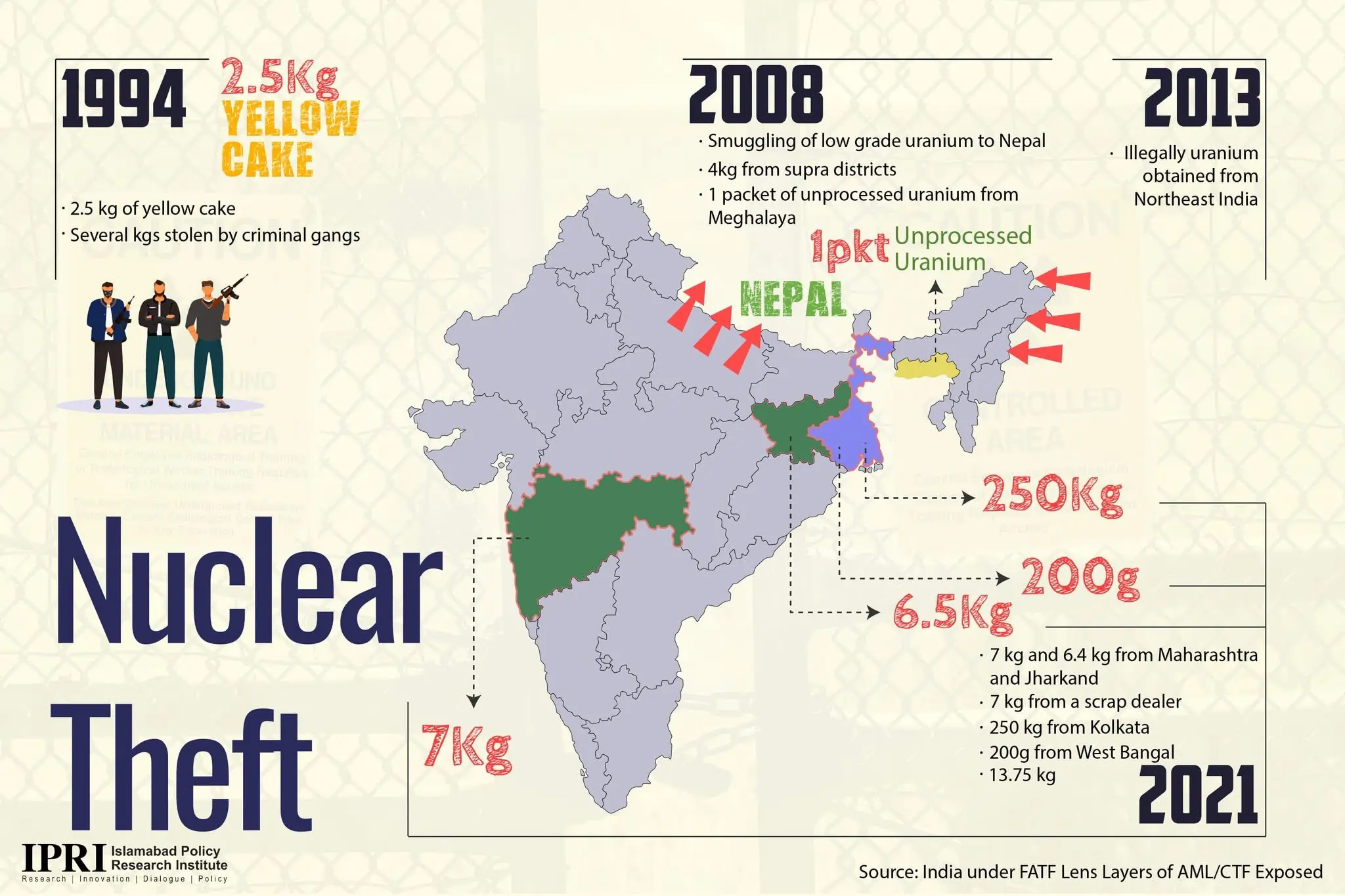
Between 1994 and 2021, there have been 18 reported cases of nuclear material theft or loss in India. Uranium on the black market. Californium in private hands. The Bhopal disaster remains the world’s worst industrial accident. And yet, no full-scope IAEA oversight. No accountability. No seriousness. Notable concerns have emerged about the independence of India’s regulatory authority, with the AERB criticized by India’s own Comptroller and Auditor General for lacking adequate autonomy from the Department of Atomic Energy.
Indian leaders routinely issue conventional threats to nuclear neighbours. It’s a uniquely juvenile understanding of deterrence — only possible in Delhi. With immature and reckless political leadership threatening a region of 2 billion people, India’s belligerent rhetoric escalates risks in an already volatile South Asia.
One lesson of the Cuban Missile Crisis was the visible posturing of No First Use policies to reduce escalation risks. Instead, India has embarked on a visible First Use threat, with aggressive and strategic attack platforms. Crisis stability theory, shaped by the 1962 near-catastrophe, warns that such posturing creates a preemptive incentive for Pakistan or China, heightening the risk of miscalculation in a tense region.
Pakistan and China, by contrast, continue to be recognised for nuclear responsibility. IAEA and US officials have acknowledged their command systems as stable and disciplined. No major nuclear accidents or incidents have been publicly reported at Pakistani facilities. Pakistan maintains its nuclear assets under tight security with a robust command and control structure through the Strategic Plans Division (SPD) and the National Command Authority (NCA). Pakistan has improved its regulatory framework, including joining several international treaties like the Convention on Nuclear Safety.
The world was lucky in 1962. It may not be again. India’s nuclear arsenal must be placed under IAEA control and dismantled — before another accident becomes a tragedy they can’t even be sorry for.

