
May 31, 2025
Note
This article was written on 31 May 2025 on X to answer a question regarding Indian Navy and any nuisance it may have.
India may suffer billions in damages and a permanent blow to its blue-water ambitions – and the world will finally settle its debate on the satellite imagery of Pakistan’s early bet on niche, smart-tech asymmetry. The Pakistan Navy’s high-tech, pack-hunting midget submarines – fitted with modular, mission-specific pods for ISR, ASW, and strike – were designed for such a moment. Surgical, quiet, and lethal.
Yet this moment of reckoning wasn’t born of strategy; it was scripted by domestic politics. Indian leadership – obsessed with optics – pushed its military into theatrical deployments for electoral headlines. That recklessness has now imperilled the entire Indo-Pacific balance. If Delhi continues to demand visible retaliation or salvaging of prestige, it risks provoking preemptive shifts in both Chinese and Pakistani nuclear postures. Strategic restraint cannot survive repeated tampering by political amateurs. What begins as showmanship may spiral into full-spectrum escalation – beyond the control of any regional actor.
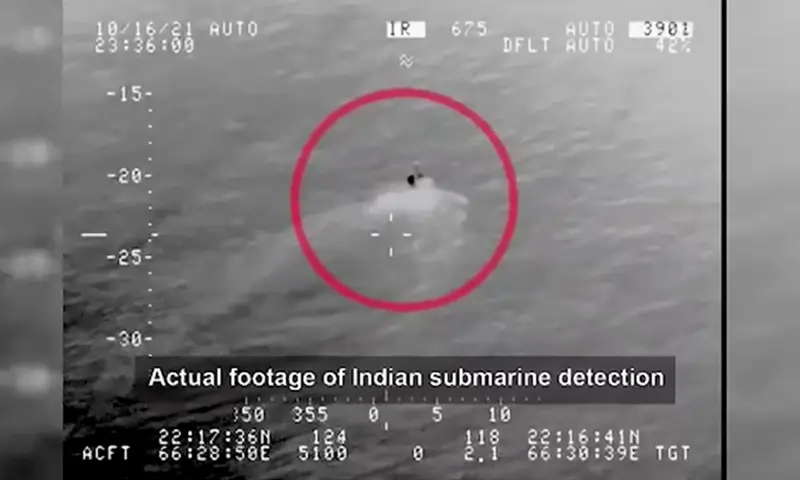
Unlike India’s overstretched and accident-prone underwater fleet, Pakistan has played a precise, quiet game at sea. Between 2016 and 2022, PN detected and filmed four Indian submarine intrusions – in 2016, 2019, 2021, and most critically, on 1 March 2022. The 2022 interception exposed India’s most advanced underwater asset: a Kalvari-class Scorpène. By tracking it inside operational waters, PN burned its acoustic profile – permanently compromising its stealth. It cannot be risked in high-threat zones again. For submarines, that is a kill without firing a shot.
This isn’t new. The Pakistan Navy has a history of overperformance under constraints – from striking Dwarka in 1965 to sinking INS Khukri in 1971, it has always punched above its weight. That doctrine of disruption remains alive in every officer today. Apart from that, India’s submarine force has suffered chronic readiness failures and basic seamanship issues. In 2018, India’s $2.9 billion SSBN INS Arihant was out of commission for nearly a year due to flooding from a hatch left open while docked. Let that sink in! In 2017, its leased nuclear attack sub INS Chakra was damaged entering Visakhapatnam. In 2024, a Kalvari-class Scorpène submarine collided with a fishing vessel northwest of Goa, resulting in two deaths. Even India’s legacy boats have fared no better – with the Sindhughosh colliding with a civilian boat in 2015. This is more evident in India’s aircraft carriers. Vikramaditya and INS Vikrant are 70s-era concepts re-skinned with vulnerable tech. The GE LM2500 propulsion system is cyber-prone. The Shakti EW suite is rudimentary. L-band radars are inadequate for strike projection and can hardly protect, and the MiG-29Ks onboard offer little beyond visual-range optics. These are not instruments of deterrence – they are $6 billion liabilities.
In contrast, Pak Navy’s air-sea integration has matured in parallel. Pakistan’s legacy P-3C Orions, despite their age, have outperformed Indian Poseidons in actual detection and engagement theatres. Multiple PN’s AIP submarines have silently breached Indian waters undetected – and these are the same class of subs that routinely shadow US supercarriers in exercises. Indian Navy stands no chance.
Pakistani naval officers were reportedly hoping India’s carriers would enter their predefined kill web rehearsed for a decisive hit. Now famed CM-400AKG – PAF spec’d and OEM produced – was envisaged to destroy carriers actually and it was a tweaked version that destroyed Indian S-400s. Publicly listed at 240–290 km range, its true envelope remains classified. Its quasi-ballistic profile and terminal hypersonic velocity were designed from the outset to defeat moving carrier targets. There’s nothing in whole Indian inventory to counter that. Let the Indian Navy make its move, and the genius behind that design will be fully realised.
This isn’t about symbolism. It’s about hard, technical overmatch. Pakistan’s naval deterrent has been calibrated, integrated, and field-proven. India has exposed its best assets – and lost them – to a quieter, faster, more adaptive doctrine.
Platforms don’t win wars. Doctrine does. Discipline does. Integration does. And the Pakistan Navy will run the same script the PAF ran: precise, humiliating, and irreversible.