
This piece began as a reply to a thread by Ammar (@rogueonomist ) arguing that delaying power generation from Diamer Bhasha, or any dam, is a good idea. The thread is numerate and carefully built, which is exactly why it deserves a numerate answer rather than a slogan. It ran long enough on X to warrant a fuller treatment here. The charts below are mine, built from the same source figures the original thread used.
The claim being answered:
A Solar+BESS combo has 61% lower capital intensity than hydro, can be rolled out in 6-18 months, while hydro takes a minimum of 8 years and remains susceptible to delays and cost overruns. […] Dams are important, but for water and flood management. There are better, more modular and efficient ways to generate power.
This is a good effort, but it falls short due to the technical limitations of the author.
I am lucky to work closely on some flagship EU projects, Gundremmingen and Coalburn , although in a very different and highly technical domain. I must begin by saying: people do not understand the complexity involved, and investment bankers plus politicians have put the whole of the EU and the USA in a tailspin compared to China.
In the UK, in NESO’s Stability Market Round 2 , every grid-forming BESS submission failed technical assessment while synchronous condensers and OCGTs took 7.3 GVA of contracts. This was after £323 million had already been spent proving BESS could do the job. The market is still paying for real inertia and real fault current, not the synthetic proxy. And Pakistan’s own January 2021 and January 2023 nationwide blackouts were restored on hydro black start. No inverter fleet black-starts a 25 GW system.
Now let me address the claims to the best of my ability, which I must say is minuscule compared to the giants I have seen in this field, even in Pakistan.
1. The Denominator Problem
Ammar is a learned person and I think he has used this metric before, but here his whole thread rests on comparing US$/kW of nameplate capacity. That is the size of the motor, not the amount of water it pumps. This is, unfortunately, the very McKinsey and Lazard style that rookie analysts use. The comparison must account for plant capacity factor, which means US$ per kWh actually delivered.
Bhasha is designed for 4,500 MW producing roughly 18.1 TWh a year. That is a capacity factor of about 46 per cent. Utility solar in Pakistan runs at 18 to 20 per cent in its early years.
Do the division on his own numbers:
- Solar+BESS at $705/kW ÷ 19% = about $3,711 per average kW actually delivered
- Hydro at $1,798/kW ÷ 46% = about $3,909 per average kW actually delivered
That is a 5% difference, not 61%.
And that is the wrong comparison anyway, because a 30% battery attach is not a dispatchable plant. The correct comparator against a reservoir is his own “100% firmed” tier at $1,200/kW, which works out at roughly $6,316 per average kW delivered. That is about 62% more capital-intensive than the hydro he is arguing against.
His own chart contained the refutation. I just did the division.
Fig 1 — Capital intensity normalised for capacity factor (USD per average kW delivered)
Quoted USD/kW divided by plant capacity factor. Bhasha 4,500 MW against roughly 18.1 TWh a year is about 46%; utility solar in Pakistan runs 18–20%. Same source figures as the original thread.
2. The Twenty-Year Window
Judging a dam over twenty years is like judging a house purchase against renting by looking only at the first five years, while you are still paying the arrangement fees.
A 272 m concrete gravity dam has a design life well past a century. Tarbela is 51 years old and its useful life now runs to around 2060. Over that period you replace the battery fleet six or seven times and the solar modules three or four times, each replacement at whatever the exchange rate happens to be on that day.
But hear this part out loud, because most analysts skip it and Ammar has overlooked it as well: the capacity charge on a dam stops when the debt is repaid. After that the plant delivers power at almost zero cost for another sixty years. It is exactly why Tarbela and Mangla are the cheapest electricity on the Pakistani system today.
One of his charts showed solar+BESS debt service going flat after year 10 and staying flat forever. That quietly assumes the batteries never need replacing. Draw both lines out to year 40 honestly and they cross.
Fig 2 — Annual cost to the consumer across the real asset life (indexed)
Illustrative shape rather than a tariff model. The crossover year moves with tenor and replacement assumptions; the topology does not.
3. Whose Bill Is It
He charges the full cost of a water project to your electricity bill, then complains that the electricity is expensive.
Bhasha is 8.1 MAF gross and 6.4 MAF of live storage. Pakistan’s large reservoirs have already lost about a third of their design capacity to silt. Tarbela alone has gone from 9.679 MAF of live storage down to 6.434 MAF in 38 years, against a sediment inflow of roughly 200 million tonnes a year.
Bhasha is credited with cutting the sediment reaching Tarbela by around 69 per cent and extending Tarbela’s life by about 35 years.
So the dam is simultaneously an irrigation asset, a flood asset, a sediment trap protecting an existing national asset, and a power plant. Allocate the capital properly across those four functions and the share attributable to electricity falls sharply.
He concedes in the thread that “dams are important for water and flood management”, and then prices them as if they were not. You cannot have it both ways.
4. A Wallet Is Not a Bank Account
A battery and a reservoir are not the same machine. This is the lesson from the 800 to 1,200 MWh projects being built across the world right now.
A battery is a wallet. A reservoir is a bank account. You cannot pay a year’s school fees out of a wallet, no matter how many wallets you buy.
6.4 MAF of live storage behind that head is something in the order of 3 to 4 TWh of stored, dispatchable energy, refilled free every year by snowmelt. Building that as lithium at $270/kWh gives you a number with twelve digits in it.
Four hours of battery, which is about the most you can go right now, is a brilliant answer to the evening ramp in July. It is not an answer to a Rabi shortfall, to a two-week December fog event, or to a low-water year.
Fig 3 — Hours of storage at full output (logarithmic scale)
Reservoir energy is an order-of-magnitude estimate from 6.4 MAF of live storage and effective head, refilled each year by snowmelt at no cost. A battery is a wallet; a reservoir is a bank account.
5. The Currency Runs the Other Way
The FX argument runs in the opposite direction to the one he claims. This matters to Pakistan as much as EVs do, and for the same reason: economic security.
Most of a dam’s cost is civil works. Cement, aggregate, local steel and local labour, all paid in rupees. The imported content is turbines, generators, gates and some components of the balance of plant.
A solar+BESS plant is cells, modules, inverters and trackers. It is close to fully imported, including the part Pakistan has a whole industry capable of localising. So per rupee of capital cost it carries more dollar exposure, not less. And it carries that exposure again at every replacement cycle instead of once.
The last I checked, the Power Division and other stakeholders were working hard to lift local content in DB’s eBOP alone from 11% to 30%. The older generation did this exercise starting with Mangla. Go and check with PEL, who now export transformers to the very USA that jump-started the Mangla and Tarbela projects on turnkey/EPC basis. Whole industries were propped up by that one initiative.
Splitting a project into tranches does not hedge currency risk. It simply books each tranche at a worse rate than the last one.
Fig 4 — Where the capital actually goes: rupee content against dollar content
Indicative split. Hydro carries its import exposure once across a century; solar+BESS carries it again at every replacement cycle. Tranching does not hedge currency, it books each tranche at a worse rate than the last.
6. “Anywhere” Is Not a Grid Strategy
“You can put solar+BESS anywhere” is not true at scale.
You can put 100 MW anywhere. You cannot put 10 GW anywhere. Beyond a certain penetration the grid needs fault current, short-circuit strength and real inertia to keep protection working and to ride through disturbances. Inverters can imitate some of this. Regulators are still not fully buying the imitation, which is the point of the NESO result above, and Iberia on 28 April 2025 showed what a converter-dominated system looks like when containment fails. The cost of that imitation, or ancillary services as it is properly called, is still best borne by BESS, and they are the most expensive assets to do that job. Not the time to delve into it.
Solar in the south still has to cross the same congested corridor to reach load in the north. That transmission cost does not disappear because the panels are modular.
7. The Self-Refuting Curve
Ammar’s own delay curve argues for finishing Bhasha faster, not delaying it.
He shows that six years of delay triples the realised cost. He then recommends delay. The money already spent is gone and is not a decision variable. The only live question is what it costs to finish per incremental firm kW. On his own curve, every year of hesitation makes that worse.
He has diagnosed the disease correctly and then prescribed it.
8. What the Spreadsheet Cannot Price
The socio-economic side is ignored entirely. Looking through the finance lens alone is what has ruined many strategic projects in the third world.
Where the money goes matters as much as how much of it there is. A dam spends the bulk of its budget inside the country: cement plants, steel, contractors, transport, roads, around 16,500 direct jobs, and a large wage bill circulating in rupees in one of the poorest regions of the country. A container of cells from Ningbo installed by a small crew keeps almost none of that multiplier at home.
Then there is water itself. Agriculture engages a huge share of the labour force. The 2022 floods cost the country roughly $30 billion. Storage is not a luxury item on an electricity spreadsheet, it is the shock absorber for a country sitting at the front of the climate queue with about a month of live storage. I have written on that in detail in The Friday Times, May 2025 .
And there is intergenerational equity. A twenty-year asset spends one generation’s money for one generation’s benefit. A hundred-year asset is a transfer to your grandchildren. It burns no imported fuel, it cannot be sanctioned, and its output cannot be repriced by a foreign commodity market.
I will be honest about the other side of this too. Resettlement in Diamer is a real human cost. Provincial distrust over water is a real political cost. Neither is solved by pretending it is not there, and the record on Bhasha’s governance is indefensible.
9. The Brownfield Blind Spot
This is the thing he is closest to being right about, and still misses entirely.
Let me bring this back to the projects I work on.
At Gundremmingen, RWE is spending about €230 million on a 400 MW / 700 MWh battery sitting on the grid connection of a nuclear plant that has been demolished. Same site, plus 55 hectares of solar and a gas plant to follow. Groundbreaking in late 2025, commercial operation in early 2028 (if some of the reports I worked on get reviewed by RWE in time :D — sorry!). At Coalburn in South Lanarkshire, Zenobē reached financial close this year on 200 MW / 800 MWh, the first four-hour transmission-connected battery in the UK to get there, with a fifteen-year toll to Drax. Coalburn 2 has also almost reached commissioning stage.
Neither project is a story about batteries being cheap. Both are stories about the connection point. In Europe a strong 400 kV connection takes eight to twelve years to obtain and is now the scarcest thing in the system. When a power station dies, the connection is the inheritance. That is the asset being monetised.
Now look at what we are doing.
GHCL has been auctioning defunct GENCO plants as scrap. Jamshoro 880 MW, Muzaffargarh 1,350 MW, Faisalabad 132 MW, a combined 2,362 MW at a reserve price of roughly Rs 26.6 billion , with barely a bidder turning up. Over thirty obsolete units then went to Wah Industries for around Rs 38.25 billion in a government-to-government transaction. The first round put up nine sites at Kotri, Lakhra, Quetta, Sukkur, Multan, Faisalabad and Shahdara.
Every one of those is a Gundremmingen. Land, a 220 or 500 kV switchyard, transmission easement, cooling water, road access, a colony and a trained workforce, all paid for decades ago by the taxpayer. We are selling the copper and giving away the connection for free.
The fix costs nothing. Unbundle the auction. Sell the boiler, keep the substation and the transmission infrastructure. Then tender the site as “X MW of firm interconnection at an existing node” for solar and storage. That is the cheapest megawatt in the country and it needs no dam and no new transmission line. If you actually want fast, modular, cheap power, this is where it is, and the thread never mentions it. I have heard that Habibullah Khan and Hassan Mansha have interests in this. Lalpir and Pakgen sit right next to that GENCO corridor. Everyone is waiting for the energy market to liberalise under CTBCM. Many brownfield scenarios are already sitting in NGC system planning files in PLEXOS.
Second Play: Turn Dead Generators into System Strength
Go back to the NESO result I opened with. Regulators are paying for fault current and inertia. A retired steam turbine generator does not have to be scrapped. Declutch it from the turbine and run the machine as a synchronous condenser: no fuel, no emissions, but real inertia, real short-circuit level and reactive support. RWE and Amprion did exactly this at Biblis (Germany). ESB did it at Moneypoint (Ireland). South Australia did it after the 2016 blackout.
Muzaffargarh, Jamshoro, Guddu and Lakhra sit precisely where solar is concentrating and where the grid is weakest for inverter penetration. Converting even a handful of those machines would be the cheapest system strength Pakistan can buy, and it would let us connect more solar, not less. That is a pro-solar argument, and it needs the carcass of a thermal plant to work.
Third Play: WAPDA’s Own Pipeline Is the Cheapest Hydro on His Chart
His first chart shows Tarbela Extension 5 as the cheapest project on the board, around $1,500/kW. That is not by luck or accident. T5 adds 1,530 MW on Tunnel 5, taking Tarbela from 4,888 MW to 6,418 MW. No new dam, no new reservoir, no resettlement, no new 500 kV line. It is brownfield hydro, and it is cheap for exactly the same reason Gundremmingen is cheap.
Mangla Refurbishment is the same logic: 1,000 MW rising to 1,310 MW, four units already refurbished and back in service, the rest scheduled to 2030, executed without shutting the station down, part funded by a USAID grant and AFD.
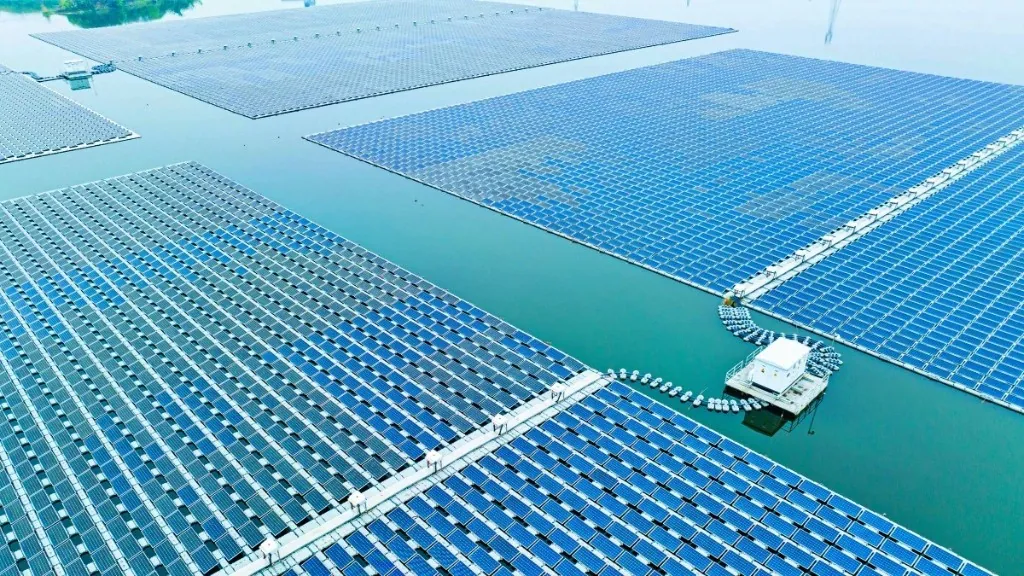
And the one nobody in this argument seems to have noticed: WAPDA had Pakistan’s first floating solar fully prepared, two 150 MW plants on the Ghazi head pond at Tarbela and the Ghazi Barotha forebay , wired straight into switchyards that already exist. WAPDA conceived this back in 2015 under a World Bank technical assistance package tied to the Tarbela extension, and the site list has since grown to include Ghazi Barotha, Khanpur and Attock.
That project is the answer to his entire thread. Floating solar on a hydro reservoir gives you cheap daytime energy on a connection that is already built and paid for, on water instead of farmland, running cooler and therefore more efficiently than panels baking at 50°C in Bahawalpur, on a dedicated 220 kV corridor that sits idle for most of the day, with evaporation losses reduced as a bonus. And the dam itself is the battery. Hold water back while the sun is up, release it at maghrib. No lithium, no rare-earth insecurity, no imports, and no replacement cycle every twelve years.
Important
It was tendered at 2.98 US cents per unit, cheaper than roughly 120 of the thermal units currently on the system, with the World Bank offering to carry 95% of a $300 million cost. It has been shelved. The government asked the Bank to pause preparation in December 2024 and the Power Division then left the scheme out of the IGCEP, both the 2024–34 and the 2025–35 plan . The cheapest firm megawatt-hours in the country were designed, tendered, financed and then removed from the plan. That, and not the concrete at Bhasha, is the thing worth being angry about.
You do not have to choose between the dam and the panel. Put the panel on the dam. (I would have called for a Nobel Prize or something, but this is a very old idea that has already gone crazy in China. Dammit, Chinese!!)
There is more of this available than people realise: canal-top solar along tens of thousands of kilometres of the world’s largest canal network, low-head units at the existing barrages, spare transformer capacity at DISCO 132 kV grid stations, and the retired IPP sites at Mehmood Kot and elsewhere whose PPAs have now lapsed. None of it requires a new right of way. All of it is faster than anything either side of this argument is proposing.
Fig 5 — Brownfield against greenfield: USD per kW installed
Mangla is PC-I cost divided by the 310 MW uplift, so it flatters the number slightly since the works also buy life extension on the existing units. Greenfield hydro figures as presented in the original thread.
Fig 6 — The argument in six numbers
Where He Is Right, and I Will Say It Plainly
Procure solar+BESS now, at volume, and do not sequence it behind anything. Better still, localise as much of the supply chain as possible. China can be a friend here. CATL and other major players are already pushing in this direction, owing to some brilliant structuring by National Grid engineers. Modularity is a genuine advantage for a state with no fiscal room. Dollar-indexed take-or-pay capacity payments are what broke this sector. Large dams do overrun, and the reference class in the literature is real. It should be used to budget honestly rather than to pretend the risk is not there.
But notice what actually broke us. It was the contract structure, not the concrete. Put the same dollar-indexed take-or-pay structure around a solar+BESS fleet and you will rebuild the identical circular debt in smaller pieces. Put a hydro asset on the public balance sheet at concessional tenor with no capacity payment and it behaves nothing like his charts.
The answer is not hydro or solar. It is solar and batteries for daytime energy and the evening ramp, built fast, and hydro for seasonal storage, water security, sediment control and system strength. All the nuclear, micro-nuclear and coal base loading is something for another time; it is not that simple, and IGCEP and its architects understand this to a greater degree.
Fix how we procure dams. Do not abandon the only asset class that stores a season and provides economic security in so many directions at once.
Note
Figures drawn from Lazard’s LCOE+ v19.0, WAPDA and PC-I project documents, NEPRA determinations, GHCL auction notices, NESO Stability Market results, and RWE and Zenobē project disclosures. Fig 2 is an illustrative shape rather than a tariff model, and the Bhasha reservoir energy figure behind Fig 3 is an order-of-magnitude estimate. My running commentary on the original thread is at @Munimusing . Analytical conclusions are my own.