
April 24, 2025
Note
This article was written 24 Apr 2025 on X, a week before the India–Pakistan aerial engagement; almost all of the speculations made in the article came out to be true and exact.
There won’t be a repeat of Operation Swift Retort. Pakistan, through its NASTP and joint command integration under the PAF’s Southern & Central Air Commands, is preparing not to mirror 2019 but to define the next confrontation on its own terms. This won’t be about a symbolic kill shot or retaliatory spectacle. It will be an invisible war of EM dominance, command latency, & the integrity of data networks. The battle will unfold across an extended architecture of sensing, jamming, coordination, & rapid decision-making, where seconds could decide sovereignty.
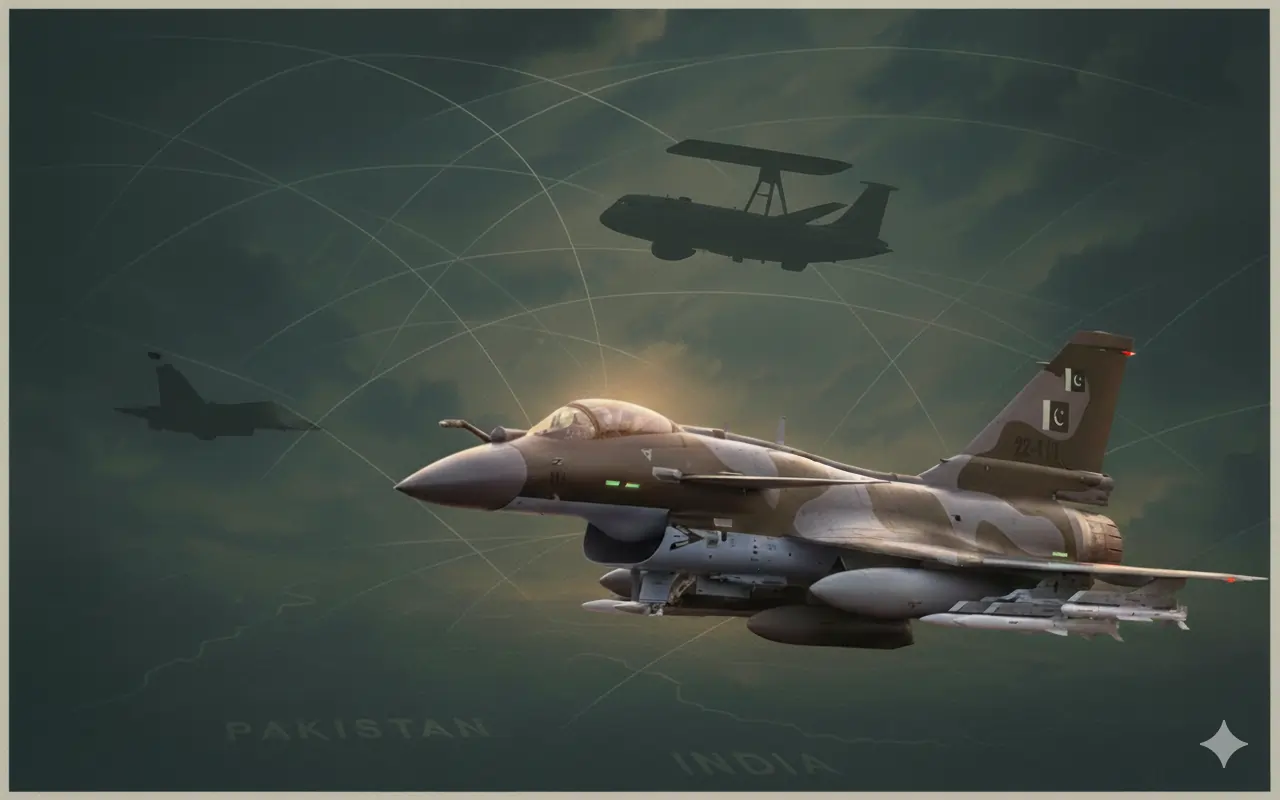
The tactical muscling is a contest between the J-10C and Rafale — both 4.5 gen. multirole platforms. The J-10C features the KLJ-7A AESA radar, PL-15 beyond-visual-range air-to-air missiles (BVR AAMs) with a reported range exceeding 200 km, and integrated Chinese ECM pods. The Rafale, by contrast, is equipped with the Thales AESA radar, Meteor BVR missiles with a no-escape zone of 60–80 km, and the SPECTRA EW suite — widely considered the most advanced in its class. But the real competition lies in doctrine, not hardware.
Pakistan’s gradual transition from a point-defense model to a layered area-denial posture will determine if it can close vulnerabilities in key ingress corridors originating from Pathankot (Jammu), Srinagar (Kashmir Valley), and Gwalior (Madhya Pradesh) axes. These axes enable low-level penetration by Rafales flying nap-of-the-earth terrain masking, exploiting radar blind spots, and launching stand-off weapons like SCALP EG cruise missiles (range: ~500 km) without fully entering hostile airspace.
Pakistan’s prior gaps in radar coverage, long command loops, and slow tactical authorisation must now evolve into a “kill web” — an overlapping, AI-augmented response network spanning airborne early warning, signal intelligence (SIGINT), and multi-platform engagement coordination. That web begins with persistent aerial sensing. The ZDK-03 (Chinese KJ-200) continues to serve as Pakistan’s key AEW&C asset alongside the Saab 2000 Erieye, though the latter provides more refined tracking and endurance. Neither, however, provides strategic EW capability. Unlike India — which maintains 13 CARTOSAT optical and radar imaging satellites and 4 RISAT synthetic aperture radar satellites for persistent overhead ISR — Pakistan lacks sovereign space-based surveillance. It also lacks a high-end, standoff jamming platform like Turkey’s HAVA SOJ or China’s Y-9G (both of which PAF is eyeing for some time now). The Falcon DA-20 (a French-built platform modified for EW roles) remains Pakistan’s only dedicated jammer, but with limited range and endurance. Until Pakistan fields a persistent, high-altitude, multi-domain jamming asset, its EW doctrine will remain reactive rather than preemptive — a key vulnerability when confronting a system like SPECTRA, which excels in localised ECM and platform survivability.
That said, SPECTRA is optimised for self-protection — not for fleet-wide ECM or theater-wide electronic denial. This opens pathways for Pakistan to exploit it. Saturating SPECTRA with multiple Digital Radio Frequency Memory (DRFM)-equipped escort drones or ECM pods (potentially deployed from modified JF-17s or unmanned systems like Shahpar-II or WZ-7 equivalents) could create false target tracks, disrupt its threat library, or overload its angular deception routines. While Rafale has excellent angular filtering, it can be pushed into mode confusion or decoy lock.
On the Pakistani side, the new doctrine of massed, digitally linked squadrons comes into play. The PAF has inducted over 130 JF-17s (Block I, II, and now III) and approximately 25–36 J-10Cs, with plans to expand both numbers. A “wolf pack” of J-10Cs and JF-17 Block IIIs — supported by upgraded Erieye and retrofitted ZDK-03 platforms, if gotten in time — can impose numerical and EM saturation within Pakistani airspace at least, where it is needed the most. With proper data fusion, centralised battle management, and coordinated use of EW pods and decoys, this force can overwhelm smaller, higher-end Rafale detachments that India fields (currently numbering 36, based at Ambala AFS and Hasimara AFS).
This confrontation is not one of raw kinematics but of system integrity. The core contest boils down to four elements: dominance of the electromagnetic spectrum, survivability and availability of AWACS coverage, missile launch and datalink logic, and hardened kill chains. Even the best missile — whether PL-15 with its active seeker and ramjet propulsion or Meteor with its two-way datalink and throttleable ramjet — becomes irrelevant if its launch authorisation is disrupted, mid-course uplink jammed, or end-phase seeker blinded. Without a hardened kill chain, even superior missiles are blind spears.
Training and rules of engagement will shape how those spears are used. Pakistani ROE has traditionally allowed decentralised tactical autonomy, particularly during heightened alert states, whereas India retains a more centralized structure — historically requiring corps- or national-level authorization for preemptive kinetic strikes. This asymmetry could become decisive in a compressed decision-making environment.
PAF pilot quality remains a key offset. Long considered tactically flexible and aggressive, Pakistani pilots and airmen are now transitioning to aircraft with more advanced workload profiles, including fly-by-wire controls, sensor fusion, and electronic threat prioritization.
In parallel, IAF pilots moving from Su-30MKIs (which use a relaxed-stability frame) to aerodynamically unstable Rafales must adapt to Western-style cockpit logic & BVR-centric tactics. In WVR combat — though statistically rare in such conflicts — both PL-10 and MICA-IR missiles offer HOBS (High Off-bore Sight) engagement, IRCCM (Infrared Counter-Countermeasures), and helmet-mounted cuing. The edge will belong to the pilot who reacts faster, denies the merge, or utilises LOAL (Lock-on After Launch) to maintain engagement flexibility despite decoys, etc!
But the strategic backdrop is even more volatile. India’s nuclear posture, though officially still “No First Use,” has shifted toward ambiguity since former NSA Shivshankar Menon’s 2016 memoir and repeated doctrinal commentary post-Galwan. With the induction of Agni-V (5000–8000 km), BrahMos-II (Mach 7+ hypersonic missile in development), and the deployment of nuclear-armed INS Arihant-class SSBNs in the Bay of Bengal, India is quietly constructing a decapitation-capable, triadic strike doctrine. Add to this the ongoing deployment of Phase II BMD interceptors (PDV and AD-1) and Russian-made S-400 batteries in Ambala, Siliguri, and Jaisalmer sectors, and Pakistan faces a shrinking response window in “use-it or lose-it” scenario. In this landscape, Pakistan’s strategic latency — the time between threat detection and credible retaliation — must collapse. The short-range Nasr (60–70 km) tactical nuclear weapon, designed for battlefield deterrence, must be publicly validated and deployed. The Fatah system (150–400 km guided rockets) with a CEP under 10m should be showcased as counterforce-capable assets. The CM-400AKG — a high-speed (~Mach 4), terminally manoeuvring air-launched missile — is ideal for punching through S-400 gaps and crippling high-value command nodes or naval assets. This must be operationally and visibly deployed. Pakistan must also accelerate Babur-III (SLBM) deployment to cement its second-strike posture. India’s BMD grid may intercept high arcs, but cruise missiles and quasi-ballistic platforms like the CM-400 stress the net horizontally — bypassing vertical kill zones and overwhelming radar-fused interceptors through saturation or maneuvering logic. Besides these, Pakistan has a lot to show that it has preferred not to in recent decade from hypersonics to tactical.
Finally, no scenario can be built solely on simulations. War-gaming, EW trial pods, and Red Flag-style exercises offer valuable data, but what works in a clean lab may fail under real-time cyber-electronic stress. Pakistan must test its kill web under denial, its ROEs under ambiguity, and its pilots under cognitive saturation.
This won’t be a contest of kills. It will be a contest of blindings. The victor will not be the first to shoot, but the last to see — and to understand what it sees. If Pakistan wins this next phase, it won’t be with a celebratory image or tea meme. It’ll be in the silence of an EM-black Rafale, disappearing over Mirpur, & in the quiet realisation that sovereignty can be asserted — not just by firepower, but by the denial of perception itself If Pakistan plays this right — tactically, doctrinally, and across the EM spectrum — it might not just deny entry, but alter assumptions in Paris, Tel Aviv, Brussels, and beyond. Sovereignty will not belong to the force that shoots first, but to the one that blinds last.
And in that silence — that moment when a Rafale goes blind — the signal may be heard far louder than any explosion.