June 26, 2025
Note
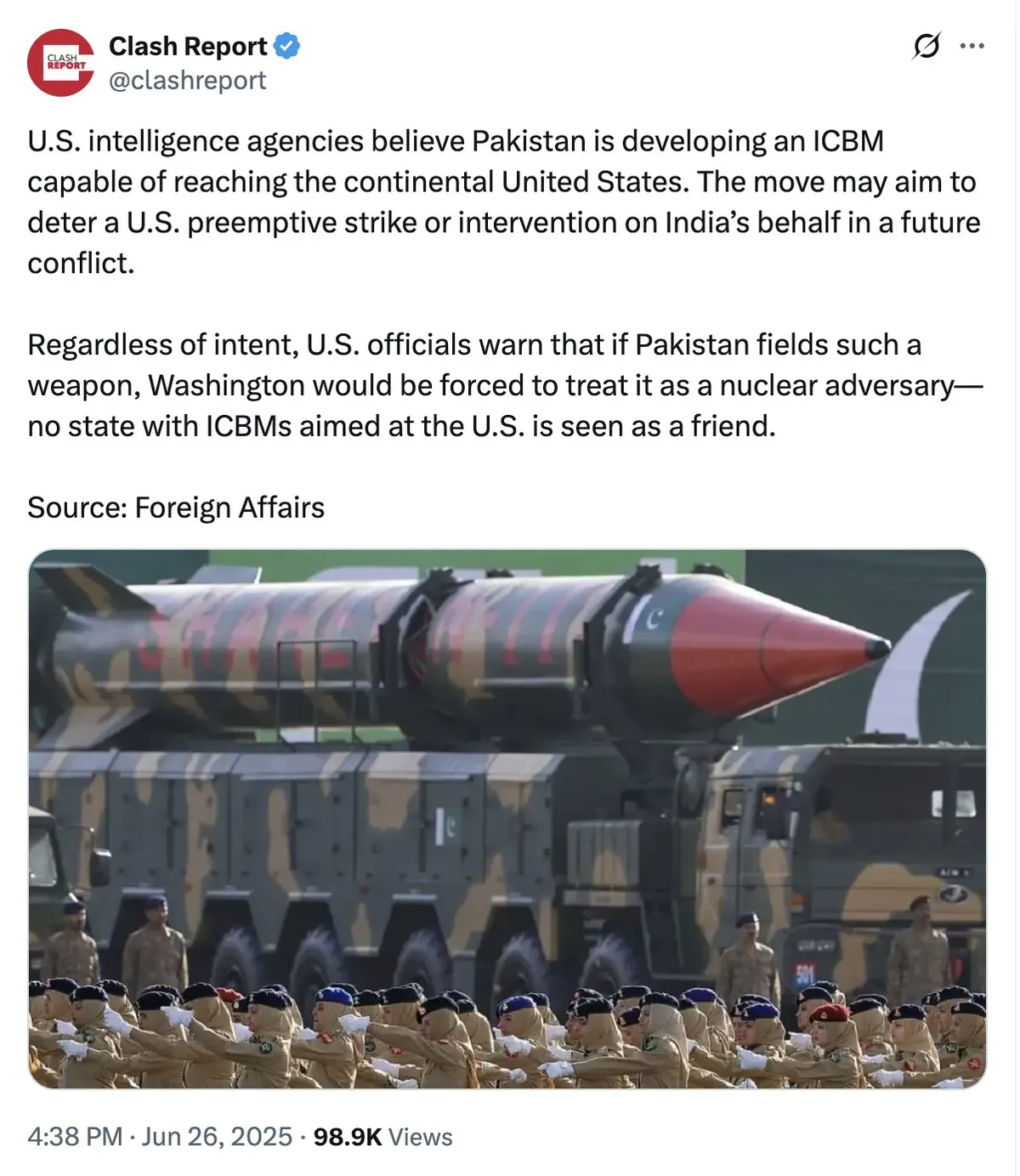
This article was written on 26 June 2025 on X, in response to Clash Report ’s amplification of Vipin Narang and Pranay Vaddi’s Foreign Affairs claim that U.S. intelligence assesses Pakistan to be developing an ICBM capable of reaching the continental United States — and that Washington would then treat Pakistan as a nuclear adversary. The piece sits downstream of the December 2024 U.S. designations against Pakistani missile-related entities. Original post: x.com/Munimusing/status/1938293305865101651 .
If the United States begins strategic posturing based on speculative assessments from think tanks infested with biblical lunatic Zionist hawks — where overhead imagery of scaled-up vertical and horizontal static test stands, high-capacity composite filament winding facilities, and clustered solid motor trials are hastily interpreted as ICBM booster core development — then the anxieties of a declining hegemon become more legible.
Pakistan already possesses the full-spectrum industrial and scientific base to field an intercontinental-range solid-fuel system such as the Taimur — or any derivative of a four-stage strategic missile platform. This includes established competencies in HTPB-based solid propellant production, segmented grain casting, carbon-epoxy composite motor casings, dual redundant INS/GNSS guidance systems – along with TERCOM, DSMAC, Star Trackers, or RLG/FOG – and TEL integration patterned on road-mobile survivability similar to DF-31A or Topol-M baselines. Wind tunnel facilities, avionics labs, and thrust vector control (TVC) mechanisms have long been demonstrated through platforms like Shaheen-III and Ababeel.
The imperative exists, particularly in the context of India’s progression under the Agni-V (5,500–7,000 km) and Agni-VI (projected 8,000–10,000 km, with MIRV capability) programmes, bolstered further by BECA-enabled target acquisition and over-the-horizon guidance enhancement via U.S.-linked ISR architecture at the service of Hindutva butchers. Still, Pakistan has chosen doctrinal restraint — capping its declared range envelope to maintain strategic ambiguity without triggering escalation beyond regional deterrence thresholds, despite American strategic malpractice to favour India.
That calculus, however, may be reaching a pivot point. The recent pattern of blatant deception, strategic opacity, and reckless escalation in service of the limitless Zionist garrison and its lunatic leadership — bypassing international arms control norms and nuclear risk management channels — has eroded the rationale for restraint. Should Islamabad opt to revise its force posture, the signals will not emerge from the public-facing cues currently paraded in open-source assessments. Those are technical misreads at best, deliberate mischaracterisations at worst.
The infrastructure being flagged — horizontal integration bays, large-scale vacuum chambers, extended flame trenches, and wind tunnel instrumentation — aligns more plausibly with hypersonic weapons development. Specifically, this includes boost-glide vehicles with depressed trajectories and terminal-phase manoeuvrability, MaRVs designed to defeat ballistic missile defence (BMD) layers, and hypersonic glide vehicles (HGVs) with lift-generating airframes and cross-range capability. These platforms are not built for general deterrence. They are designed to preempt preemption — to reach hardened targets and strategic enablers across the Indian Ocean littoral with velocity and terminal manoeuvrability that collapse the enemy’s reaction time. In clear words, these are doctrinally intended to neutralise India’s expanding first-strike enabling toolkit — which, apart from Agni and MIRV ambitions, now includes the operationalisation of nuclear-powered ballistic missile submarines (INS Arihant, Arighat) and carrier ambitions (Vikrant, Vishal). New Delhi’s force posture is shifting toward left-of-launch, preemptive decapitation fantasies of strategic paralysis. Beyond that, India is laying the groundwork for expeditionary basing outside the immediate ballistic missile envelope of Pakistan — from the Andaman-Nicobar Command to island staging posts in the Indian Ocean. These are not survivability hedges; they are enablers for a first-strike architecture. And they incentivise Pakistan to shift toward a confirmed counterforce deterrent — not simply survivable second-strike capability, but precise, assured retaliation at distance and speed.
The real American anxiety, seemingly, is not about Pakistan developing ICBMs. It is about Pakistan fielding a DF-17–class hypersonic system, fused with hardened kill chains that actually work. Unlike Iranian systems which saturate, these would hit — with assured CEPs low enough to qualify as counterforce, not just punitive. Chinese ISR and SATCOM assets, already demonstrated in operational integration via the PL-15 and other BVR systems, provide the real backbone — the full ISR-to-strike cycle extending into open sea. This bypasses the reach limitations of Pakistani UAVs or manned air sorties over contested waters.
That’s the real flashpoint: Pakistan’s pursuit of credible deterrence against India’s ambiguous first-strike posture has collision geometry with U.S. forward-deployed naval assets. If Pakistan fields precision-strike hypersonics with assured satellite-backed terminal guidance, it gains the power to impose cost on naval formations far beyond its littoral — not as a rogue actor, but as a rational state refusing to allow its nuclear deterrent to be challenged by templates made for the USSR, North Korea, and China, and now openly employed by that minion of the US! If Pakistan crosses that threshold, it becomes the fourth state with that class of anti-access/area denial (A2/AD) capability.
It is just hardcore deterrence theory. It’s about denial of the illusion of victory.