
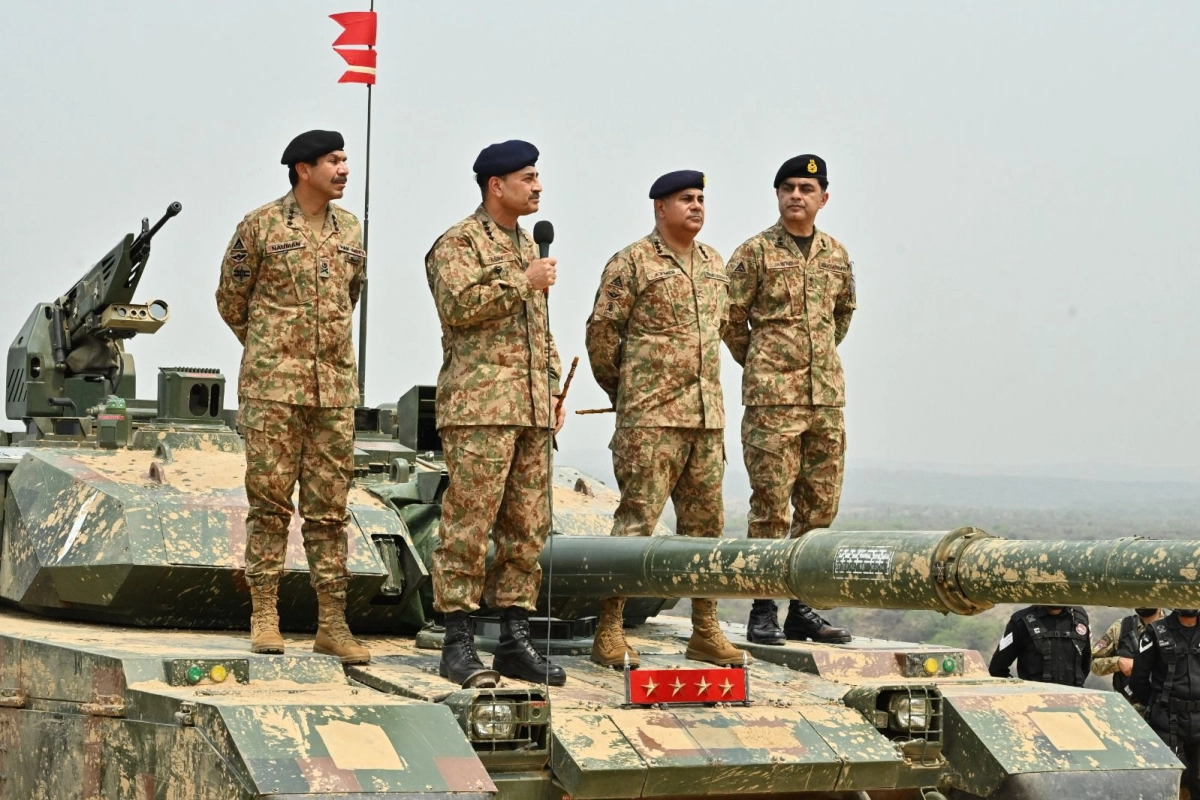
This piece began as an expansion of senior journalist Ajmal Jami’s comment beneath the recording of Lt. Gen. Nauman Zakaria’s address to the IISS Shangri-La Dialogue 2026 special session on “Managing Threats to Strategic Stability.” Jami’s observation prompted a longer thread, and the thread warranted a longer treatment. The context is a post on X in which I cited the following passage from my article in The Express Tribune, June 2025 :
The danger is that Pakistan’s ROEs will evolve past Riposte and into deterrence-by-interdiction. Any visible IBG buildup near the border, or persistent scavenging for sub-strategic manoeuvre space under the nuclear ceiling, may trigger a counter-concentration strike before hostilities formally begin.
Unlike Russia or China, Pakistan doesn’t operate behind oceans or with redundancy. It operates with existential immediacy. It cannot afford to absorb. Its threshold is not calibrated in megatons, but in minutes.
Glad that someone brought that up. That was much needed at the time.
The Exercise Behind the Address
The image that became iconic speaks for itself. The exercise being witnessed is Hammer Strike, conducted on 1 May 2025 at the Tilla Field Firing Ranges in Jhelum – a high-intensity field training exercise led by Pakistan Army’s I Corps, the Mangla Strike Corps. COAS attended personally.
Hammer Strike is a whole theory, and those who study it properly should put the name of Lt. Gen. Nauman Zakaria squarely among its architects. He has commanded I Corps since May 2024, and before that, he served as DGMO at GHQ – the precise billet from which Pakistan’s offensive operational planning paradigm is shaped. His HI(M) and Sitara-e-Basalat decorations, the latter awarded for his conduct during the May 2025 India-Pakistan conflict, speak to the operational weight he has carried.
What Hammer Strike Actually Is
The theory carries several inevitable outcomes, the foremost being the conversion of what was structurally a defensive posture into an offensive deterrent – which is precisely what Lt. Gen. Nauman is alluding to in his Shangri-La address. This is a qualitatively different class of thinking from the reactive hedging that characterised previous generations of senior leadership.
The Indian side has not yet fully absorbed the strategic burden Pakistan is shouldering alone, though the onus of disciplining Indian adventurism rests at least as much on the Western capitals that have been steadily pampering New Delhi’s strategic narcissism.
The Galwan Opening
Hammer Strike is built directly upon a vulnerability that the Galwan crisis of 2020 exposed.
Following the Galwan clashes of June 2020, in which 20 Indian soldiers were killed, India was forced to dual-task and ultimately redirect its Mathura-based I Corps – historically the senior of its three Pakistan-facing strike formations – toward the Ladakh front. By December 2020, Army Headquarters had issued written orders reassigning I Corps to a mountain strike role, converting its two infantry divisions for operations against China.
The Ambala-based 2 Corps and Bhopal-based 21 Corps were to retain their role as tank-heavy forces, equipped and trained to advance deep into Pakistan in wartime, while the third strike corps – the Mathura-based 1 Corps – was reassigned to become a mountain strike corps oriented toward Chinese territory from Ladakh.
This rebalancing constitutes a major commitment and a costly signal; re-tasking a strike corps is not simply a matter of pointing forces in a different direction. The conversion into mountain infantry requires retraining and re-equipping that will take years to complete and will be extremely difficult and costly to reverse.
The Arithmetic That Changed
This is the structural opening Hammer Strike exploits.
In an active war scenario, Pakistan’s two strike corps would have had to contend with what were originally three Indian strike corps on the western front; post-Galwan, that arithmetic has materially shifted. Hammer Strike doubles down precisely on this window.
The operational concept envisages a high-fidelity, extremely fast armoured thrust northward through the Sialkot-Shakargarh corridor – the Ravi-Chenab axis – driving hard toward the southern foothills of Jammu and Kashmir and seizing and holding that terrain.
This corridor is not chosen arbitrarily. It is the same Ravi-Chenab corridor through which India’s I Corps launched the Battle of Chawinda in September 1965 – still among the largest armoured engagements since the Second World War – and where the Shakargarh bulge, that tongue of territory jutting between the Chenab to the northwest and the Ravi to the southeast, creates the decisive terrain for any northern offensive.
The theory postulates an aggressive advance in the Day 1 scenario and, from that seized terrain, the encirclement of Indian formations arrayed from Lahore to Multan as a secondary operational objective within Day 2 and Day 3. This logic maps directly onto both the procurement programme and the doctrinal re-alignment visible across the aviation, armoured, and mechanised formations.
The Anvil Formations
Alongside modernising the armoured corps, Pakistan has in recent years been strengthening and modernising the mechanised divisions under IV Corps (Lahore), XXX Corps (Gujranwala), XXXI Corps (Bahawalpur), and V Corps (Karachi).
Unlike I Corps Mangla, the Multan-based II Corps and these formations are not the offensive instrument – they are the anvil: configured to absorb, attrit, slow, and hold Indian thrusts across the Rann of Kutch, Sindh, and southern Punjab while the strike element does its work in the north.
The Doctrinal Lineage
Hammer Strike is the mature next iteration of the New Concept of War Fighting (NCWF), the joint doctrine Pakistan formalised in 2013 following four Azm-e-Nau exercises run between 2009 and 2013 – a body of work initiated by General Kayani as a conventional counter to India’s Cold Start Doctrine.
Between 2009 and 2013, the Pakistan Army conducted these exercises to formalise and operationalise a conventional response to Cold Start, at the conclusion of which Pakistan adopted the NCWF, aimed at improving mobilisation time and enhancing inter-services coordination, especially between the Army and the PAF.
What Hammer Strike adds over NCWF is offensive depth, exploitation logic, and an integrated understanding of how India’s two-front dilemma can be converted from a chronic Pakistani vulnerability into a structural advantage.
The PAF Parallel
Lt. Gen. Nauman’s role in this is, perhaps, directly analogous to what Air Marshal Aamir Masood – the one you see now on screens – did for the PAF’s air warfare doctrine.
AM Aamir Masood was commissioned in 1988 as a fighter pilot, graduated from the Combat Commanders’ School, and volunteered into the squadron that would have answered a very plausible Israeli adventurism right on the occupied territories during the 1998 tests; Sq. Ldr. Amir Masood was said to have spent the better part of May 1998 strapped into his cockpit. He eventually served as DCAS (Training) at Air Headquarters before his promotion to Air Marshal in July 2020.
He was among the founders of the Aerospace Centre of Excellence (ACE), which serves as the home for combat commanders, houses the school for standardisation of operational publications and the aggressor squadron, and hosts the Air Warfare School for national and international composite operations and exercises. PAF ACE was formally established at PAF Base Mushaf, Sargodha, with its groundbreaking in 2016, with the PAF’s Combat Commanders’ School subsequently placed under its command.
The BVR capability, deep studies of Indian foremost assets – Oniks (BrahMos), S-400s, and Rafales – and air combat doctrine that underpinned the PAF’s performance in the February 2019 engagements and later in May 2025 did not emerge spontaneously. It was built methodically through the institutional machinery that AM Aamir helped construct, largely out of public view, over the better part of a decade.
Lt. Gen. Nauman Zakaria’s contribution to Hammer Strike is the land equivalent of that work: institutional, doctrinal, and now being presented – with deliberate timing – on the floor of Shangri-La.
The author is an engineer and strategic commentator based in Ireland. He writes on South Asian security, military doctrine, and geopolitics at abdulmun.im and on Substack .