
May 10, 2025
Note
This article was written on the night of 10 May 2025 on X, at the threshold of PAF’s launching of Phase 3 of Operation Bunyan um Marsoos / Marqa e Haqq.
As we write this, President Trump and Secretary Rubio have announced a brokered ceasefire between India and Pakistan, with both sides agreeing to dialogue on a neutral platform. This marks a sudden shift in the conflict’s tempo. However, the fragile nature of this ceasefire cannot be ignored. While the diplomatic optics favour de-escalation, the underlying strategic dynamics remain dangerously volatile. The US administration has limited strategic leverage to enforce a sustained ceasefire. Its hawkish posture, poor and mannerless leadership, internal polarisation, and precedent of using ceasefire negotiation as a tool of military manoeuvring suggest that this truce may be more transactional than enduring. India, drawing lessons from Israel’s de-escalation charades, may use this pause to regroup without addressing the core escalation triggers.
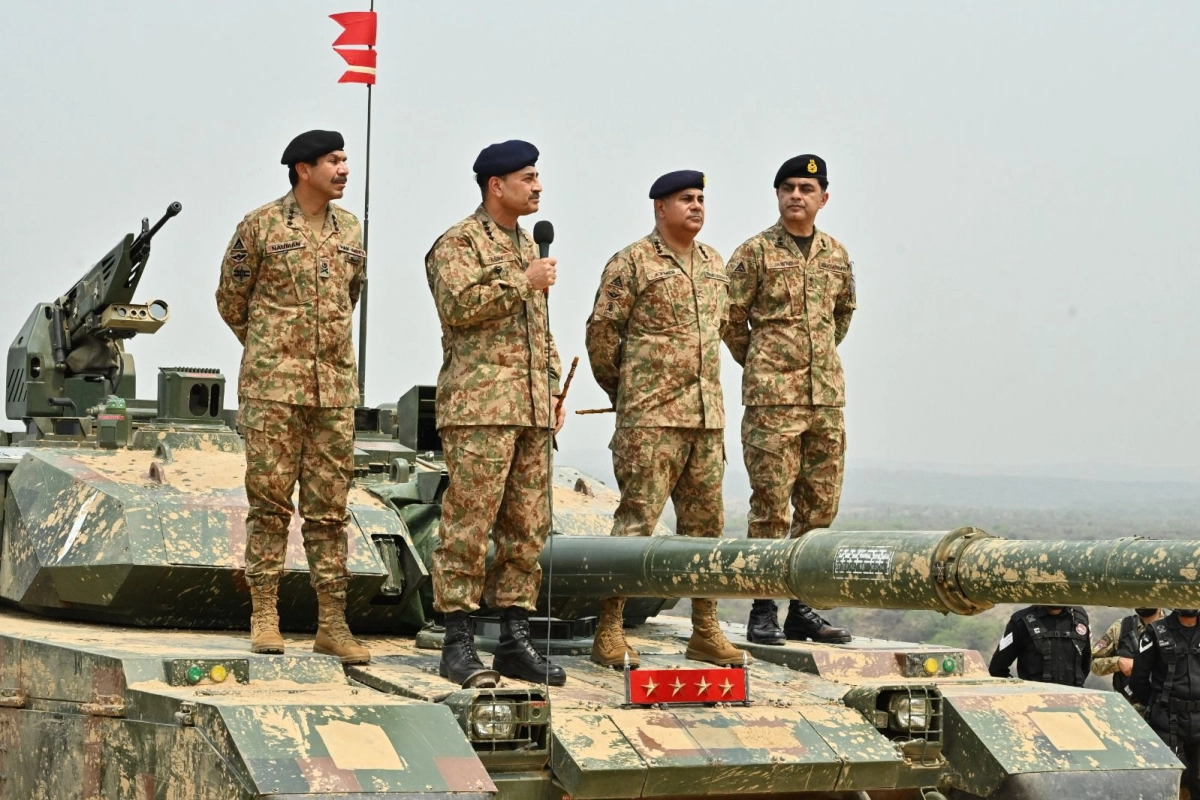
Considering this, Pakistan may recalibrate its signalling and escalation posture around India’s strategic calendar to – elections, BRICS–G20 optics – to sway global narratives and engage pivotal third-party actors like China, KSA, and the EU. The recent signalling optics of Army Chief around Strike Corps I’s live field exercise, Hammer Strike, few weeks ago, must now be seen in sharper relief.Stationed at Mangla, this Corps is Pakistan’s primary armoured spearhead – tasked with launching deep, high-tempo thrusts into enemy territory, particularly Indian Punjab and the southern sectors, in the event of full-scale war. Its doctrine centres on manoeuvre warfare: encirclement, blitzkrieg-style penetrations, and dislocation of Indian forward formations, logistics hubs, and command nodes to force Integrated Battle Groups (IBGs) into capitulation. But Hammer Strike was not a mere rehearsal of legacy tactics, it was, I believe, strategic signalling – both calibrated for escalation and reflective of an accurate reading of India’s evolving force posture. India’s long-standing belief that it could secure a conventional upper hand against the Pakistan Army is increasingly deluded.
Indian strategic intent now visibly orbits around changing the status quo in Azad Jammu and Kashmir. This is no speculative reading – it stems from years of doctrinal realignment, theatre command simulations, logistical prepositioning, and long-standing BJP’s political rhetoric. The post-2019 shift from defensive postures to Cold Start–inspired, IBG-driven offensive posture is clearly visible. The BJP is intent on projecting strength over Kashmir, and what has changed is not India’s doctrine, but its risk appetite and the perceived decoupling of nuclear deterrence from conventional options. The post-Pahalgam tactical reality up until this morning and the upcoming elections have only accelerated this momentum.
Yet terrain and logistics impose hard constraints. India’s Northern Command lacks the strategic depth and corridor flexibility to sustain armoured operations in the Kashmir theatre. High ridgelines, single-approach valley roads, and canalised terrain limit manoeuvre space and leave Indian formations exposed to interdiction. However, India can still launch limited vertical thrusts – capturing tactically advantageous high ground along the LOC in a ‘Kargil-in-reverse’ – aided by real-time drone and satellite ISR. The objective here is less about territorial gain and more about political signalling, deterrence messaging, and psychological leverage – a typical outcome of what Modi and BJP want.
To mask this northern play and stretch Pakistan’s attention, India is posturing visibly in central and southern Punjab. The theatre is textbook Cold Start: a forked offensive across IBGs, one pressing for symbolic seizure of heights in Kashmir, the other intended to draw and fix Pakistani formations in the plains and desert sectors. Cyber offensives and precision long-range fire support further enable tempo generation, aiming to collapse Pakistan’s decision cycle.
Pakistani military establishment has not remained idle. The operation Bunyan um-Marsūs this morning, marks the fusing of its kinetic and non-kinetic capacities into a hybrid retaliatory matrix. With over 26 Indian military installations struck by the PAF, including the claimed neutralisation of an S-400 system, and a concurrent cyber disruption that peaked with knocking out over 70% of western India’s power grid, Pakistan has demonstrated not only reach but the will to escalate decisively. The message is clear: escalation dominance remains BJP’s illusion. Within this shifting theatre, X Corps will evolve from a static LOC defence command to an active kill-zone orchestrator. Armed with dense ISR coverage, Turkish and indigenous MALE UAVs, high-resolution jamming from Koral-plus and domestic EW platforms, and multi-domain reconnaissance, X Corps is now a dynamic disruptor. Its mandate is to absorb Indian thrusts, collapse their logistics, blunt forward movement, and expose flanks to drones and airpower. Despite ISR advantages via BECA-linked satellites and Israeli drone feeds, India faces hard geospatial asymmetry in the north. Pakistan’s reverse slopes, enfilade coverage, and pre-registered artillery fire zones favour defence. Pakistani Northern Corps mitigates ISR exposure through multispectral camouflage, decoys, and signature suppression, blunting sensor-to-shooter chains.
Add to this the PAF’s integration into Army ISR loops enabling dynamic CAP rotations – with F-16s securing air denial corridors, JF-17s executing interdiction, and EW units spoofing IAF comms and radars to blind Indian CAS and ISR over the whole theatre.
Strike Corps I, meanwhile, is held in calibrated readiness. Its current ROE in battle order, I believe, is no longer about reflexive deep incursions across the international border. Instead, it is postured for shallow, high-impact strikes within a 10–15 km envelope –targeting logistics degradation, C2 interdiction, and shaping the battlefield for political messaging. The objectives will not be those traditional – striking targets in Ganganagar, Abohar–Fazilka sector, or deeper thrusts towards Bhatinda or Malwa region. The staging posture, it seems, is not to occupy territory but to puncture the Indian offensive rhythm, enforce high economic and human cost, and signal that any decoupling of conventional and nuclear thresholds is an illusion.
Remember that Strike Corps I is central to Pakistan’s “Riposte Doctrine” (a counteroffensive war-fighting concept), designed as a response to India’s Cold Start Doctrine. The corps’ objective – by design – is not to hold ground but to deliver decisive blows that shape the outcome of the war quickly before international pressure halts operations. SC-I also has a role in Pakistan’s nuclear threshold management under very declared and detailed Full Spectrum Deterrence doctrine, implying conventional and tactical nuclear linkage. SC-I gives the leadership the room in escalation control, potentially bringing the conflict to Pakistan’s declared nuclear red lines.
This brings us to Strategic Plans Division (SPD) and Army Strategic Force Command, responsible for the mobility and deployment of Pakistan’s strategic and tactical nuclear weapons. Both would be on forward-alert protocols. Pakistan has progressively decentralised its ISR, C2, and nuclear C4I architecture into redundant nodes to ensure survivability against decapitation strikes and first-wave cyber offensives. Nasr batteries – Pakistan’s theatre-wide, first-use tactical nuclear systems – are designed for 30–50 km depth strikes without crossing into strategic exchange thresholds. These are likely being dispersed under hardened C4I links, supported by mobile decoys and pre-programmed response ladders. Since 2019, Pakistan has institutionalised tactical nuclear deployment as a procedural, not purely strategic, function. Deployed near Punjab and Kashmir choke points, these platforms serve dual roles: active battlefield denial and re-linkage of nuclear deterrence to conventional thresholds. These are not weapons of last resort, they are real-time recalibrators of Indian risk calculus by detering or neutralising Indian IBG penetrations. Therefore, all Indian sane voices must understand that any adventure beyond operational phase lines risks inviting a graduated nuclear response.
This is no longer a mere Cold Start–versus–Riposte paradigm. It is a doctrinal convergence within an asymmetric matrix. India aims to apply short, calibrated, multi-domain pressure to coerce strategic concessions and recast the cost of Pakistan’s support for Kashmiri people. Its underlying thesis is economic attrition: can Pakistan endure a $10–15 billion war spillover while preserving national cohesion and deterrent credibility? Pakistan’s counter-thesis is escalatory ambiguity: to inject uncertainty, punishment, and protraction into every rung of India’s offensive ladder.
This is decision-cycle warfare. India signals readiness to spend blood and treasure to redraw the strategic map of Kashmir. Pakistan signals that any such attempt will trigger surgical denial, kinetic rebalance, and nuclear ambiguity. When it had nothing in 1947–48, Pakistan still went on the offensive in Kashmir. That DNA has only hardened with time. The centre of gravity remains Kashmir, but the domains of contestation now span cyberspace, spectrum, and strategic messaging.
India may likely proceed with a limited multi-axis push – heavy on ISR and cyber edge, calibrated on an escalatory scale. It will seek to establish facts on the ground in the north while stretching Pakistani reserves across central and southern theatres. Pakistan will likely absorb the blow while concurrently disrupting the tempo and logistics behind Indian IBGs. Pakistan’s counter-mobility doctrine – integrating UAV-deployed mines, pre-registered artillery, and engineered demolitions of key transit nodes – aims to disrupt India’s rear-echelon surge from central and southern commands. X Corp will likely to be used to crush northern advances, and Strike Corps I will act as a scalpel, not a hammer – imposing cost without triggering strategic entrapment.
And just like in the case of PAF vs Rafales, when the radio broadcast of the battle commanders goes silent in Jammu valley – radios still clutched in hand, airwaves poised – Pakistan’s tri-services will have delivered shockwaves precisely where they were meant to land. As for the naval theatre, the world will soon learn what Pakistan was doing with midgets.